“MRS. CAT” of No. 40 FIRST PL. (1925)
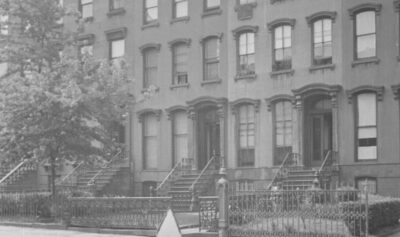
******************************************************************************************************************************** Brownstone Detectives investigates the history of our clients’ homes. The story you are about to read was composed from research conducted in the course of one of those investigations. Do you know the history of YOUR house? ******************************************************************************************************************************** (Ed.’s note: The following story comes from the Tues., 1 September 1925 issue of the Brooklyn Daily Eagle; it tells the all-to-familiar story of a woman removed from her home for keeping too many cats.) “The aftermath of the third successive raid by agents of the S. P. C. A. on an old brownstone house at 40 1st pl., occurred today, in the Fifth Avenue Court with the arraignment of George H. Ingraham, nephew of the eccentric Mrs. Gertrude Hale, who for a score of years had made the house a haven for homeless cats, on a charge of assault. A 7-year-old girl, who the police say was injured when Ingraham hurled a milk bottle at a battery of photographers in front of the house, made the complaint against Ingraham. “In last night’s raid on the house three agents from the society went through the building from top to bottom and nabbed 10 cats of all sizes and descriptions, which they removed in an ambulance to the society’s headquarters. This made a total of 27 cats captures in the home of the eccentric recluse, though the agents estimated that at least an equal number of cats had escaped from the premises. The other 17 cats were captured in raids made Friday […]
“LUCKY” No. 13 POLHEMUS PLACE (1904)
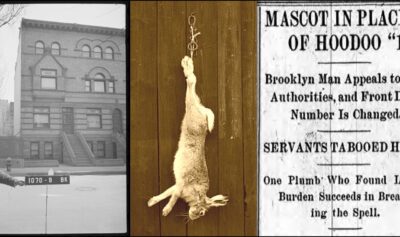
******************************************************************************************************************************** Brownstone Detectives investigates the history of our clients’ homes. The story you are about to read was composed from research conducted in the course of one of those investigations. Do you know the history of YOUR house? ******************************************************************************************************************************** (From the Chicago Daily Tribune, Fri., 11 November 1904.) Ed.’s Note – If your house number was “13,” would you hang a rabbit’s foot on your door, cover up the unlucky number, change it? These were all suggestions by the Commissioner of the Street Numbering Bureau to Brooklyn citizen Henry Brooks Plumb when Plumb arrived in the commissioner’s office hoping to change the integer attached to his door – No. 13 Polhemus Place. ____________________________________________________________________________________ New York, Nov. 10. – [Special.] — The street numbering bureau of Brooklyn told Henry B. Plumb of 13 Polhemus place today that he could scratch the hoodoo off his front door. It gave him a neat slip of paper authorizing him in the name of the borough of Brooklyn to substitute a numerical mascot. He was told under the powers of the permit, that he could hang the left hind foot of a rabbit caught in a graveyard at midnight under the new number in case the hoodoo proved stubborn. Maybe Plumb can get a servant now. Mrs. Plumb is hopeful. There is an air of optimism and cheerfulness about the family in marked comparison to the gloom and depression of those bitter days when Bridget and Mary Ann and black Hannah and tow-headed Gretchen shuffled […]
TAMING THE BROWNSTONE MONSTER (1921)
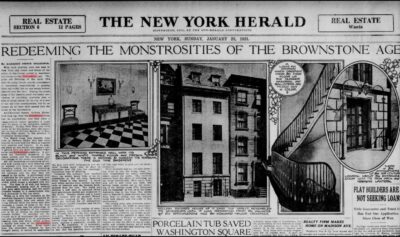
******************************************************************************************************************************** Brownstone Detectives investigates the history of our clients’ homes. The story you are about to read was composed from research conducted in the course of one of those investigations. Do you know the history of YOUR house? ******************************************************************************************************************************** By the 1920s, many New Yorkers had moved on from the brownstone. In fact, articles were being written on just how exactly to move on from what was seen as these “monstrosities.” Following the recommendations of self-appointed design entusiasts and contractors with an eye for the moderne, many brownstone townhouses were shaved of their detail and turned into drab brown boxes. The following story, dripping with sarcasm and barely veiled condescension, appeared in the New York Herald, showing just how the monstrosity at No. 17 East 75th Street was tamed.– Courtesy of The New York Herald, Sun., 23 January 1921 By HARRIET SISSON GILLESPIE. With each passing year one sees in New York city fewer and fewer of the relics of the horror period in American architecture the brownstone age. The grim old dwelling of the early 80’s with its sulky facade and its atmosphere of oppressive respectability is passing from our midst, but no one seems broken hearted over the fact. During the acute stage of the housing panic the hasty conversion of anything available into a hive of small suites rid the city of a few of the old time monstrosities, but by no means all of them have passed into the limbo of the kitchenette. Architectural beauty doctors […]
YE OLD TIMBER TAVERN ON COURT ST (1926)
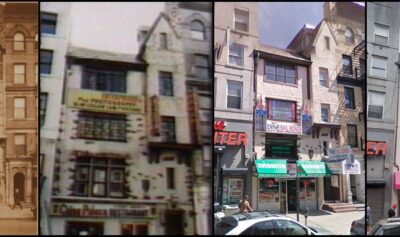
******************************************************************************************************************************** Brownstone Detectives investigates the history of our clients’ homes. The story you are about to read was composed from research conducted in the course of one of those investigations. Do you know the history of YOUR house? ******************************************************************************************************************************** Old English architecture is a rare sight in New York City. Rare, interestingly, because it once had a distinct place and time in the history of New York City’s 20th century architectural development. As tastes changed, however, its look – sometimes referred to as Tudor, Chester, Jacobean, Elizabethan, &c. – quickly fell into disfavor. Also, its reliance upon such materials as wood and stucco – those that can easily wear if not well maintained – forced owners of these structures to look for more long-term solutions to their maintenance. One of these solutions usually meant simply covering their more wearable materials with those that stood up better to weather. Although it would take nearly a century to do, such is the case with No. 93 Court Street, initially designed in the Old English style. “Brooklyn’s most distinctive office building,” started a Brooklyn Daily Eagle article in October of 1926, “may well be the description of the new home of Malkind & Weinstein, architects, which is being completed at 93 Court st., and is expected to be ready for occupancy in November.” The article went on to highlight the building’s design and beauty. “The building will carry out the style of Old English architecture in every detail in its exterior, while the […]
THE SPITE HOUSE OF MELROSE AVENUE (1899)
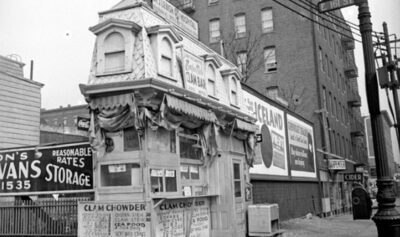
******************************************************************************************************************************** Brownstone Detectives investigates the history of our clients’ homes. The story you are about to read was composed from research conducted in the course of one of those investigations. Do you know the history of YOUR house? ******************************************************************************************************************************** Around the turn of the last century, Melrose Avenue in the Bronx was widened. The land that the city needed to perform this expansion was purchased from private owners. In some cases, however, it left some very-difficult-to-build-on lots. Such was the case with a lot on the corner of East 161st Street and Melrose Avenue. From The Strand Magazine, 1899. “This odd building stood on the corner of 161st Street and Melrose Avenue, New York City. It was a bit over 4ft. in depth, 17ft. frontage, and one and a-half storeys high, with a basement and sub-basement built under the broad sidewalk, extending to the curb. The house itself was of wood, on a steel frame, and had a slate roof. “Its owner was an eccentric tailor, who lived and carried on his trade below the street. The interior consisted of a small show-room, a store-room, and spiral iron stairway going down to the ‘lower regions.’ “The upper storey seems to have been constructed merely as a finishing touch. It was reached by an iron ladder from the store-room. The entire construction, appointments, and fittings were very ingenious, and were all the ideas of the owner. “The story of the house was that the original lot was cut away in opening […]
IS THAT A TUB IN YOUR KITCHEN? (1920)
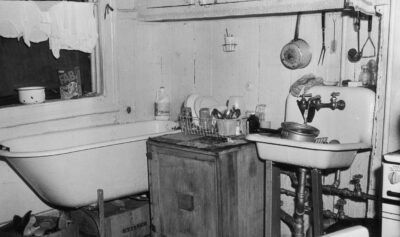
******************************************************************************************************************************** Brownstone Detectives investigates the history of our clients’ homes. The story you are about to read was composed from research conducted in the course of one of those investigations. Do you know the history of YOUR house? ******************************************************************************************************************************** The following article tells how a young lady’s visiting relation – during the New York City housing shortage of 1920 – thought it would be simple to quickly find her niece a $50 (a month!) apartment in Brooklyn – and how, upon viewing one in Brookyn Heights, she was shocked – “Shocked, I say!” – to see a bathtub in the kitchenette (or a kitchen in the bath)! – Courtesy of Brooklyn Daily Eagle, Sun., 22 August 1920 AUNT BELLA is an august soul and very imposing in her handsome second mourning. And she set her tea cup down with a force Which made me nervous for my Royal Sevres. “You needn’t tell me,” said Aunt Bella firmly. “This Housing shortage is all a myth, and is cooked up between the newspapers and the property owners to keep up the high rents. You haven’t looked, child—you admit it yourself. Right here in Brooklyn there are, I know, hundreds of apartments, kitchen, living room and bath. Here you sit and let your rent go up 25 percent, and don’t make a murmur. That will be $62.50 for this box of a place. Nonsense!” as I weakly murmured something about the intense heat. “It Would be cheaper to take a taxi today and […]


