A MORBID MYSTERY IN PARK SLOPE (1940)
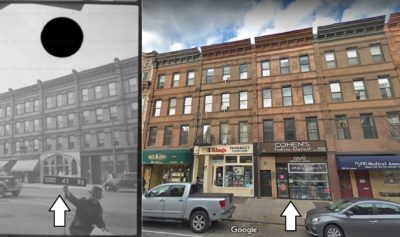
******************************************************************************************************************************** Brownstone Detectives investigates the history of our clients’ homes. The story you are about to read was composed from research conducted in the course of one of those investigations. Do you know the history of YOUR house? ******************************************************************************************************************************** When researching our clients’ properties we often come across some pretty outrageous stories, fantastic histories, and some strangely enigmatic images. During a recent review of some of the city’s tax photos featuring properties in Brooklyn from the 1940s, we came across this very interesting, yet certainly fleeting (it no longer exists), architecture constructed into a storefront on Brooklyn’s Seventh Avenue (see the left side of the photo above). It is apparent, from the rest of the neighboring storefronts, that No. 298 Seventh Avenue’s facade had been altered at some point, but to what end? The modified storefront projected a very gothic image that told passersby that something very different – and important – was going on within the building. We wondered was it a chapel, a little church, a museum? Unfortunately, the resolution of the city’s tax photos are often too grainy to make out much detail, so we had to look elsewhere for answers. We, thus, resorted to the archival images of Brooklyn newspapers to determine what had existed at No. 298 in the 1930s/1940s. When the following image popped up in our search results, all was made clear. No. 298 Seventh Avenue was a second-to-final destination for many Park Slope Brooklynites: Follow @BrownstoneDetec Share ———————————————————————————————————————– The Brownstone Detectives Brownstone […]
WHEN BROOKLYN’S SUBWAYS WERE CAVING IN
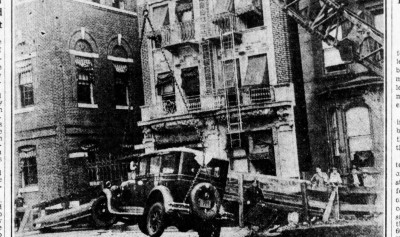
Back in the day, when subways were being dug throughout the city, cave-ins were a common occurrence. Very often these cave-ins were caused by water leakage or seepage, or heavy rains. As such, the City began to run drainage water in overhead tubes to keep the area near the subway digs in-tact. Follow @BrownstoneDetec ———————————————————————————————————————– The Brownstone Detectives The story you have just read was composed from historical research conducted by The Brownstone Detectives. It was uncovered during the extensive research that our clients commission us to perform on their historic homes, research which culminates in the production of one of our celebrated House History Books. If you are interested in discovering the history of your home, contact us today.
PVT. EDWIN RUOFF (A BEDSTUY HERO) (1918)
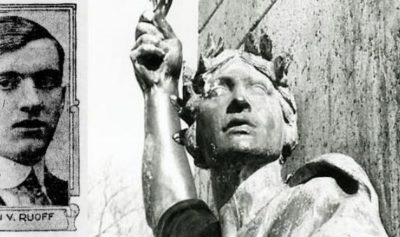
******************************************************************************************************************************** Brownstone Detectives investigates the history of our clients’ homes. The story you are about to read was composed from research conducted in the course of one of those investigations. Do you know the history of YOUR house? ******************************************************************************************************************************** In 2014, The Brownstone Detectives partnered with the New York City Parks Department to help celebrate the lives of the servicemembers of Bedford-Stuyvesant Heights who made the ultimate sacrifice during the Great War. We researched these heroes to locate pictures, stories, and their descendants to be brought together for a ceremony that dedicated a new “Victory and Peace” war memorial at Saratoga Park. This biography tells the story of one of those servicemembers. PVT. EDWIN V. RUOFF Before being drafted into the U.S. Army to fight in the Great War, Private Edwin V. Ruoff was a resident of Stuyvesant Heights where he lived at 193 Ralph Avenue. He was killed in an accidental bomb explosion on 3 June 1918 in France, when a supposedly harmless shell went off. The explosion, which took the lives of 45 soldiers in total, occurred when the company was drilling. It all started when one of the men discovered the “bomb or hand grenade” and “began fooling with it.” Then, “after tossing it about and whirling it around, he let it drop. As the missile hit the ground, there was a terrific explosion, the force of which threw almost every member of the company to the ground.” THE ARMY VISITS MRS. RUOFF According to the Brooklyn […]
THE HIPSTERS OF WARTIME FORT GREENE (1864)
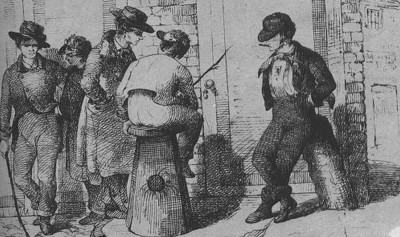
******************************************************************************************************************************** Brownstone Detectives investigates the history of our clients’ homes. The story you are about to read was composed from research conducted in the course of one of those investigations. Do you know the history of YOUR house? ******************************************************************************************************************************** “I lean and loafe at my ease observing a spear of summer grass.” Walt Whitman wrote this line at the beginning of the poem that later became “Song of Myself.” Whitman was a self-styled loafer. And, in the mid-1800s, loaferism was not a very popular pastime – excepting, of course, with the loafers. Loafers, to bring the term into a modern day focus, were the rowdy hipsters of their times – non-conforming, proudly different, and not at all afraid to show it. “…(T)he age abounded in loafers. There were literary loafers, Yankee loafers, French loafers, genteel loafers, common loafers, and country loafers, among others…” noted Michael Zakim a paper entitled, The Business Clerk as Social Revolutionary; or, a Labor History of the Nonproducing Class. “(L)oaferism was essentially a metropolitan phenomenon,” he continued, “haunting the city’s sidewalks, wharves, museums, and parks, and serving as a ready epithet for anyone needing to hurl an insult.” And insults and rowdyism seemed to be what they did best. The newspapers are filled in ante- and post-bellum times of accounts of loafers, how bad they were, and what the good, upright, and moral citizens were to do about them. “Loafers were known for cursing without shame and for smoking cigars,” Zakim noted. “They cared little for […]
JACK THE RIPPER IN BROOKLYN HEIGHTS (1889)
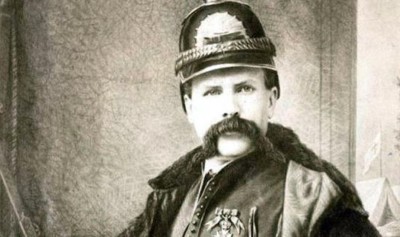
******************************************************************************************************************************** Brownstone Detectives investigates the history of our clients’ homes. The story you are about to read was composed from research conducted in the course of one of those investigations. Do you know the history of YOUR house? ******************************************************************************************************************************** The residents of Brooklyn Heights had always seemed to have much more to fear from one another than from the butcheresque stylings of London’s Jack The Ripper. His fiendish work had been performed with the great learnedness of a doctor, but, comfortingly, it had been executed all the way across the Atlantic in the East End of London. It was likely because of this distance that Brooklynites felt free to regale in the stories of the Ripper’s murders and to wonder at the identity of the modern-day butcher. On 18 January in 1889, however, all of that may have changed, when a man using the “common, every day” name Smith stepped up to a Brooklyn Heights boarding house – with his bag and great trunks en tow – and quietly checked himself in for a long stay. TWOMBLEY, THE INDIAN HERB DOCTOR The former “Indian herb doctor,” who had, through “judicious and extensive advertising, managed to make a handsome income,” engaged Mrs. Lamb’s rooms, where he also took his meals. Dr. Francis Twombley, also known as Tumblety, in his former life in the U.S. – for he was born and raised in the States – had, in the early 1860s, had an office and laboratory on Fulton Street, near Nassau. (According […]
COL. BACON KISSED THE WIVES (1905)
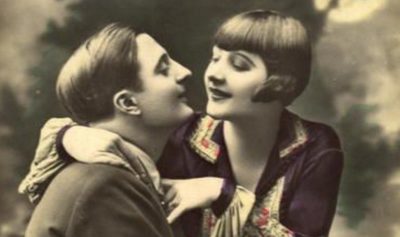
It is a shame the way newspaper reporters don’t write these days. The folksy, tongue-in-cheek, gossipy style of 100 years ago would today seem too daring, too familiar. And perhaps newspapers now are just a little too gun-shy of potential libel suits… Here is a story reported by the Brooklyn Daily Eagle in 1905, that combines all the elements of a ribald over-the-fence tittle-tattle: Brooklyn Daily Eagle, Fri., 20 October 1905 — The home makers and home defenders of Prospect Park South were stirred this morning to dark purposes. Quite well it was that Colonel Alexander S. Bacon got away from Ditmas Park home in that aristocratic section before his neighbors saw the morning papers in which the gallant colonel was depicted in the very act of kissing their wives. Not only that, but the same papers had Colonel Bacon declaring publicly that he had been enjoying sweet osculatory favors. It all grew out of Colonel Bacon’s law business. He was defending Mrs. Hortense Powers from the suit of her husband, William F. Powers, who wanted a divorce on the ground that Mrs. Powers had been too free with her kisses and favors for a neighbor, “Billy” Campbell. Colonel Bacon tried to excuse and justify these little tokens of affection. Here is the argument he was reported to have used before the jury: “Gentlemen, every one of you who is married probably has kissed his neighbor’s wife. Without wishing to be egotistical, I might say that I have been fortunate […]


