The Burning of Mayor Wood’s Home (1855)
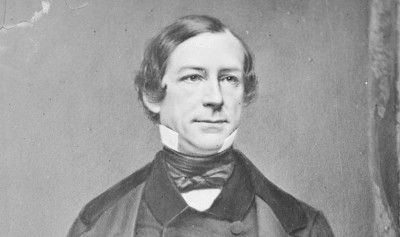
One of the buildings involved in yesterday’s horrific conflagration in the East Village had at one time been the residence of a New York City mayor infamous for his suggestion during the Civil War that New York City secede from the Union. According to an 1855 New York Times news-story, that mayor, Fernando Wood, lived at No. 121 Second Avenue (today, No. 123). Apparently, this 4-story and basement single family residence would be his home for many years. The fiercely political 2-term mayor was known for his leadership of Tammany Hall and for a system of massive patronage in city government that would eventually lead to emergence of Boss Tweed. Wood’s initial image, though, was one of anti-corruption, as, while living at his Second Avenue home, he was hailed for rooting out the extensive corruption that was rife within the New York Municipal Police Department at the time. According to the East Village/Lower East Side Historic District Designation Report, 123 Second Avenue was constructed in 1834. It subsequently underwent numerous alterations over the years, one of which likely occurred around 1911 when Second Avenue was famously widened – it was in that action that the building’s stoop and yard were removed. The numbering, also, was altered at some point. The current No. 121 Second Avenue was previously No. 119 Second Avenue, and today’s No. 123 Second Avenue (Wood’s residence) was then No. 121 Second Avenue. Follow @BrownstoneDetec ———————————————————————————————————————– The Brownstone Detectives The story you just read was composed from historical […]
THE GENTRIFICATION OF SARATOGA PARK (1896)
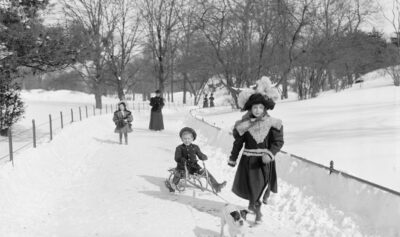
******************************************************************************************************************************** Brownstone Detectives investigates the history of our clients’ homes. The story you are about to read was composed from research conducted in the course of one of those investigations. Do you know the history of YOUR house? ******************************************************************************************************************************** Around the mid-1890s, the public in the Eastern District of Brooklyn – in what would come to be known as the Stuyvesant Heights section of Bedford-Stuyvesant – began clamoring for a space for a local park. There were three things driving this support: 1) the extension of the Brooklyn street grid system, along with 2) failing attempts by local governments in keeping pace with the growing population in the 25th Ward, and partly due to 3) the success and popularity of Central Park in Manhattan and Prospect Park in Brooklyn. As a result, the City’s aldermen, sensing the growing aspiration for “breathing space” in the locality, went looking around for an adequate stretch of land to acquire for a park – something that would suit the local residents. After a thorough exploration within the ward, the City’s elders settled upon a square little more than 3 acres in size, bounded by Halsey and Macon streets, and Howard and Saratoga avenues. Other than the fact that it was in a very desirable location, it was really the only choice they had – it was the single available piece of undeveloped land in the district of its size. O! And then there was the price… JAMES CLINTON BROWER ENTERS THE SCENE This singular […]
BROOKLYN MORTALITZ (1863)
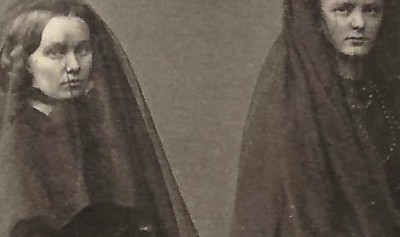
******************************************************************************************************************************** Brownstone Detectives investigates the history of our clients’ homes. The story you are about to read was composed from research conducted in the course of one of those investigations. Do you know the history of YOUR house? ******************************************************************************************************************************** In the summer of 1863, an average of 89 Brooklyn infants were dying each week of cholera infantum. Otherwise known as “summer complaint,” it was a sort of prostrating gastroenteritis that affected infants during hot weather. Just as cholera was characterized, the version for infants was associated with “vomiting, profuse watery diarrhea, fever, prostration, and collapse.” There were all sorts of “cures” sold to the public by quacks looking to get rich. One was “Mrs. Hayes’ Dysentery Syrup,” which promised that for “the cure of cholera infantum” it has no equal.” As the field was unregulated, though, most “cures” consisted of sugary water compounds which gave much hope but little else. Brooklynites, though, were also dying of other maladies that week, most notably “consumption (16), congestion of the brain (13), convulsions 913), marasmus (12), scarlet fever (7), hydrocephalus (7), inflammation of the lungs (5), diarrhoea (7), drowned (5), &c.” That week 177 people died within the city, “of which 58 were adults, 124 children; males, 89; females, 88; colored persons, 3.” Among the various “Nativities,” these mortalities affected citizens of “U.S., 142; Ireland, 18; Germany, 8; Scotland, 3; England, 2; British America, 2; Unknown, 2.” Not surprisingly, death was more of a part of life back then and people took it […]
WE’RE VOTING TODAY – SEE YA T’MORROW!
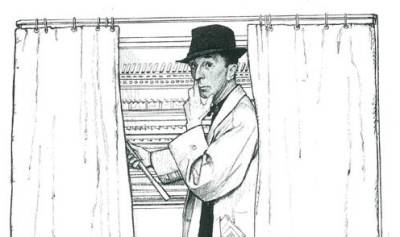
We’re voting today. So we’ll see you tomorrow! If you need to find your polling place – look HERE! Follow @BrownstoneDetec ———————————————————————————————————————– The Brownstone Detectives This story was composed from research performed by The Brownstone Detectives. Allow us do an in-depth investigation of your house and its former owners and produce your very own House History Book. Your hardbound coffee table book will include an illustrated and colorful narrative timeline that will bring the history of your house to life. Contact us today.
“SWEATING” HALLOWEEN TOYS IN 1921 BROOKYLN
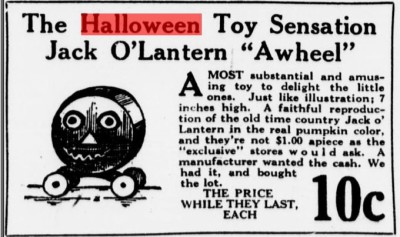
How this toy worked is quite simple, but apparently, at least according to this ad in the October 31st, 1921 edition of the New York World, it was a “most substantial and amusing toy to delight the little ones.” The ad further noted that the Halloween Toy Sensation, the Jack O’Lantern “Awheel,” was “7 inches high,” and was a “faithful reproduction of the old time country Jack o’Lantern in the real pumpkin color.” In reality it was simply a locally mass-produced means of making money off of an annual holiday. The toy was probably made of wood which was placed on a base with wheels and hand-colored by some young ladies in a sort of “sweat shop” somewhere in Brooklyn. As a seasonal item they were probably produced quickly in a carpentry shop and assembled at a rapid pace – then the girls likely learned how to hand color the “faces” as they went along. “Awheel” was an old word which meant to travel by auto or bicycle and was used in a similar fashion to “afoot.” This Jack O’Lantern, obviously, was traveling by wheel – “to the delight the little ones.” And at 10 cents a piece, it sounded like a deal. Follow @BrownstoneDetec ———————————————————————————————————————– The Brownstone Detectives This story was composed from research performed by The Brownstone Detectives. Allow us do an in-depth investigation of your house and its former owners and produce your very own House History Book. Your hardbound coffee table book will include an illustrated […]
TIMEWARP TUESDAY! FULTON ST. FERRY TERMINAL (1900 v. 2014)
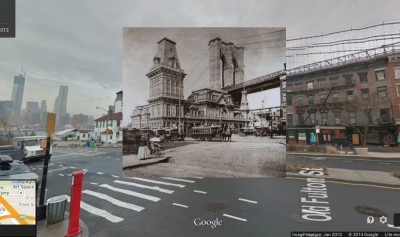
“Fulton Street, north side, at Water Street, showing the old Fulton Street Ferry Terminal and the Brooklyn Bridge tower. This is also a street car line terminal.” So reads the back of this ca. 1900 photograph. At that time, the ferries would land at the foot of Fulton Street and the streetcars – then horse-drawn – would take passengers to various parts of the borough. Here is a picture of this spot today: And the picture from 1900: Follow @BrownstoneDetec ———————————————————————————————————————– The Brownstone Detectives This story was composed from research performed by The Brownstone Detectives. Let us do an in-depth investigation of your house and its former owners and produce your very own House History Book. Your hardbound coffee table book will include an illustrated and colorful narrative timeline that will bring the history of your house to life. Contact us today.


