DESIGNING A BETTER BROWNSTONE (1888)
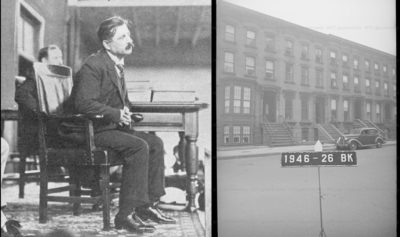
******************************************************************************************************************************** Brownstone Detectives investigates the history of our clients’ homes. The story you are about to read was composed from research conducted in the course of one of those investigations. Do you know the history of YOUR house? ******************************************************************************************************************************** Current owners of brownstones know the time and cost investment necessary to renovating the ancient structures. After 125 years or so of constant use and abuse, it is understandable that, like with humans, things tend to sag, break, and otherwise, go out of date. Thus their constant renovations and redesigns. But did you know that our brownstones have been undergoing renovations – since they were built? At No. 278 Lafayette Avenue, an Italianate brownstone in the Clinton Hill section of Brooklyn, one such renovation – likely the rowhouse’s very first – took place in 1888, just 20 years after the construction of the building. While the redesigned was feted at the time, the owner’s name would go down in infamy… AN INFAMOUS OWNER OF AN OLD BROWNSTONE In 1904, an excursion steamship called the General Slocum sank in New York City’s East River. The craft had been chartered to carry members of the St. Mark’s Evangelical Church (a German-American community in Manhattan) to a church picnic when it foundered. According to Ship Ablaze, a book written about the disaster by author Edward T. O’Donnell, of the 1,342 people on board – mostly women and children – 1,021 drowned. The disaster decimated an entire section of New York City and caused the […]
WHEN BUSHWICK MET OCEAN HILL (1923)
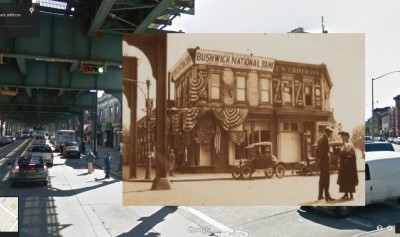
******************************************************************************************************************************** Brownstone Detectives investigates the history of our clients’ homes. The story you are about to read was composed from research conducted in the course of one of those investigations. Do you know the history of YOUR house? ******************************************************************************************************************************** “Ocean Hill” was still settling softly into the Brooklyn lexicon of place names as a working class suburb in 1923. Bushwick, on the other hand, was already very well-known in the borough for its German breweries and beer gardens. But where the two met – and they met, all right – there were SPARKS! (…or maybe a bank or real estate office….) This snapshot was taken at the intersection of Broadway and Hopkinson Avenue (later to be renamed Thomas S. Boyland Street). The building there on the corner in 1923 held the Bushwick National Bank and Frederick W. Erdtmann’s real estate offices. The Bushwick National Bank came into existence the same year that this photograph was taken – probably the reason for the photograph and the patriotic bunting all around the building; the bank ended up merging with the Globe Exchange Bank in 1929, and so had a short life of about six years. Frederick W. Erdtmann, a realtor who lived at 868 Macon Street and then above his real estate offices in this building, had filed for bankruptcy in 1913 before this photo was taken. He was back in the real estate business by 1919 and did well for himself in the 1920s. Who the old woman and the young […]
GUERRILLA MARKETING IN A DRESS (1903)
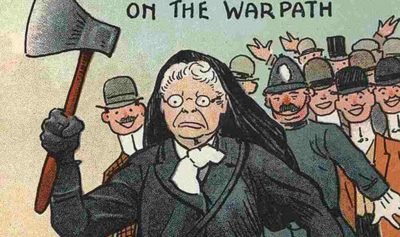
******************************************************************************************************************************** Brownstone Detectives investigates the history of our clients’ homes. The story you are about to read was composed from research conducted in the course of one of those investigations. Do you know the history of YOUR house? ******************************************************************************************************************************** When Brooklyn saloon owners saw Carrie Nation entering their Broadway establishments carrying her ax, their first thought was to protect their liquor. But when that grand and radical old figure of the Victorian temperance movement approached their bars, they were stunned at her request. “Gimme a drink – or else!” The original goal of Nation’s ax-swinging was to promote the temperance movement through the visual image of the destruction of its foe – liquor. It brought new prominence to a movement whose most visual image to date had been old women lambasting the drinking ways of men. When she started swinging that ax, though, she got attention, and so, in extension, did the temperance movement. CARRIE NATION – COMES TO BROOKLYN? But Nation, whose anti-saloon message was promoted primarily in Kansas, was a shocking sight in the Eastern District of Broadway. She had recently visited New York City, though, and so no one was willing to challenge that ax in the bars up and down the avenue – even so close to the liquor center of Brooklyn – Bushwick Avenue. “Dressed in a plush sacque, a neat fitting skirt, an old fashioned bonnet and carrying in one hand a dilapidated carpet bag and in the other a wooden ax, a person, […]
THE BOY HOODLUMS OF HANCOCK STREET (1899)
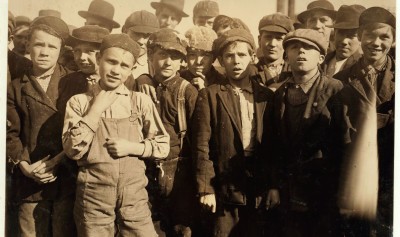
******************************************************************************************************************************** Brownstone Detectives investigates the history of our clients’ homes. The story you are about to read was composed from research conducted in the course of one of those investigations. Do you know the history of YOUR house? ******************************************************************************************************************************** If you were a boy hoodlum in “Bed-Stuy” back in 1899, then it is a good bet that you conducted your “outrages” along that stretch of Howard Avenue between Halsey and Hancock Streets. For it was there that a “small reign of terror” was “inaugurated” during this period, as small gangs of boys “armed with sticks and stones” prowled about the area with determined mal intent. A NEIGHBORHOOD COMPLAINS – THE EAGLE RAILS “The irrepressible and unregenerate young generation of boys in the vicinity of Howard avenue and Halsey street are making existence a heavy load to the law abiding population of that community,” railed the Brooklyn Daily Eagle. “The choicest lot of hoodlums in the city have banded themselves together,” the paper continued “and use that block as a fixed center, from which they conduct a campaign of well planned outrages for a radius of many blocks around.” A CASE IN POINT Two boys, in particular, were reported to the police after having assaulted a “little 10 year old boy who was going to the grocery store for his mother.” The boys, a 14-year-old member of the Earle family living at at 73 Howard Avenue and a boy named Goldstein, living at 96 Howard Avenue, “led the charge upon the […]
HOW CASEY THE COP SPELT “KOSCIUSZKO” (1904)
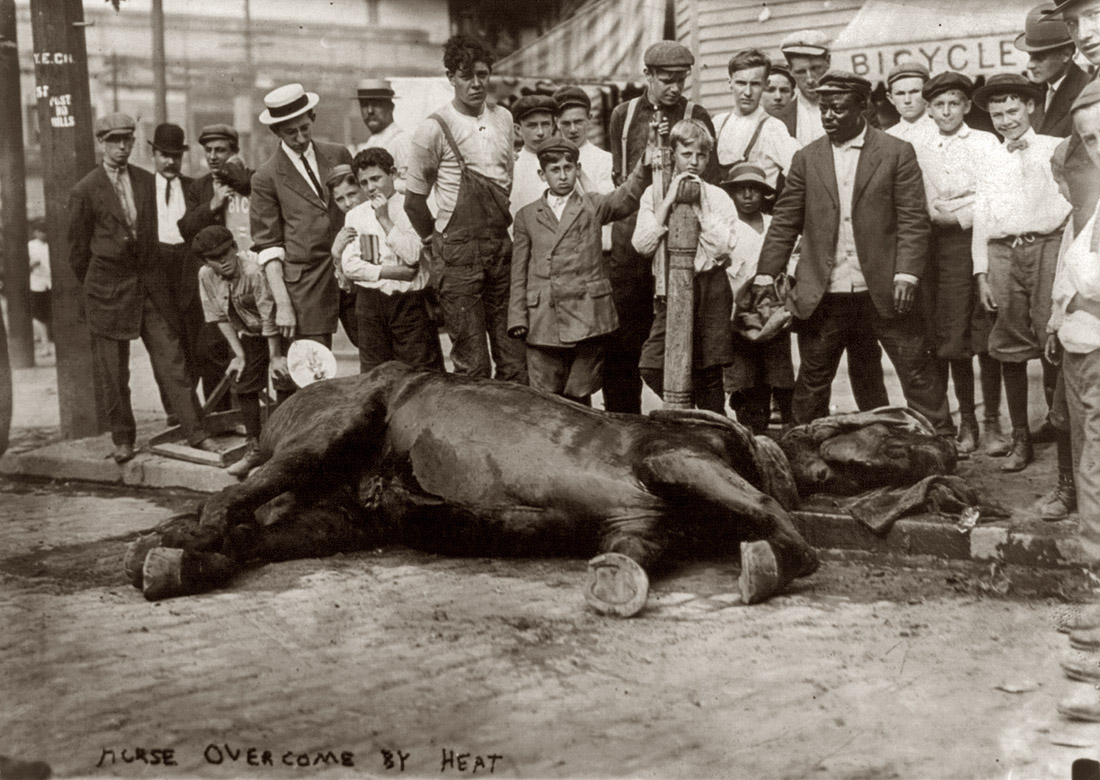
******************************************************************************************************************************** Brownstone Detectives investigates the history of our clients’ homes. The story you are about to read was composed from research conducted in the course of one of those investigations. Do you know the history of YOUR house? ******************************************************************************************************************************** Andrzej Tadeusz Bonawentura Kościuszko was a Polish military officer who helped the U.S. to gain independence from the British during the Revolutionary War. Because of his dedication there are numberous public locations named after him – including a street in Bed-Stuy. Even more numerous, though, are the tales about the difficulty in spelling the man’s name. The best tale, though, involves a tail – and a horse and a policeman. SPELLING KOSCIUSZKO “There was once an Irish policeman who was responding to the presence of a dead horse on Kosciuszko Street. Upon arriving at the scene of the dead horse, Casey began to write his report. When he got to the part where he was supposed to write the location in which the horse was discovered, the policeman faltered. “He did not know how to spell the street name. “So, Casey looked at the horse and then at his report, and he thought. A few moments later, he shoved the half-finished report in his cap, grabbed the horse by its tail, and began dragging it down the street to the corner of Marcy Avenue. Once there, he stopped, pulled the report out from his cap, and added the ‘location’ of the dead horse – ‘Marcy Avenue.’” By the way, back in […]
BROOKLYN’S FIRST DAY OF SCHOOL (1916)
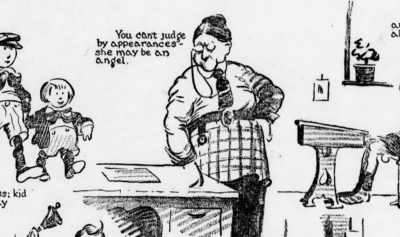
******************************************************************************************************************************** Brownstone Detectives investigates the history of our clients’ homes. The story you are about to read was composed from research conducted in the course of one of those investigations. Do you know the history of YOUR house? ******************************************************************************************************************************** At the beginning of the school year in 1916, the Brooklyn Daily Eagle published a set of cartoons, in its Sunday, 17 September edition, lampooning the first day of school for children, janitors, teachers, and parents, alike. We faithfully reproduce the graphics and the accompanying musing here: “Funny things really happen on the first day of school, though most of us don’t like laughing just then We have to wait until we are in a happier frame of mind. Do you remember the boy who always starts the year by being late? He wouldn’t make an exception of the first day – that would be against his principles. You see, he has only had three months to get to school on time, so you can’t expect him to do it on such short notice. In the last five minutes of those three months he suddenly realizes that he is late. Then he rushes and gets to class just three minutes overdue, and very much out of breath. “There are girls like this, too, but they are not so numerous as the boys. Girls as a rule get to school on a much more regular time schedule than boys. There are four reason for this; they like school better; they fear teacher […]


