A STUDY IN DISMEMBERMENT (1914)
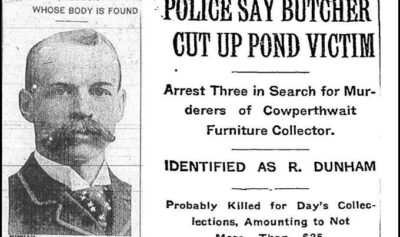
******************************************************************************************************************************** Brownstone Detectives investigates the history of our clients’ homes. The story you are about to read was composed from research conducted in the course of one of those investigations. Do you know the history of YOUR house? ******************************************************************************************************************************** When the pieces of a dismembered body started showing up in different locations in Brooklyn around Christmas of 1914, it didn’t take long before Brooklyn Detectives traced those body parts to a block on Macon Street in the Stuyvesant section of town. “The two pieces of torso which were found on Friday by boy skaters embedded in ice in a pond between Coney Island and Ulmer’s Park were identified yesterday afternoon as parts of the body of Rufus Dunham, 61 years old, of 752 Macon Street, Brooklyn.” So began the article that was to create a great sensation on Bedford-Stuyvesant’s Macon Street between Ralph and Howard avenues. DREDGING UP THE PAST When we uncovered this story a few years back, we had been researching a house on this block of Macon Street (near to Howard Avenue) for our first House History Book. We had thought it would be interesting to see who else had lived on the block over the past 125 years. During our historical research, up popped this gruesome and sensational story which must have created quite a stir on the block at the time. SEARCHING FOR THE KILLER The murder case, described as “one of the most disturbing that police of the city have had to cope with […]
HALLOWEEN ON THE SUBWAY (1922)
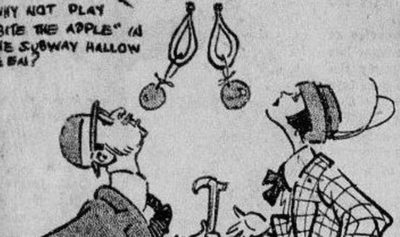
******************************************************************************************************************************** Brownstone Detectives investigates the history of our clients’ homes. The story you are about to read was composed from research conducted in the course of one of those investigations. Do you know the history of YOUR house? ******************************************************************************************************************************** Those of you who live in New York might have seen costumers on the subway during your commute today. It is less likely, though, that you saw straphangers bobbing for apples. At the time of this cartoon’s publication in the October 29th, 1922 edition of the New York Tribune, the subway was a mere 18-year-old. And the term “straphanger” was not much older – it derived from the (at first leather, and later metal) straps which hung from the ceiling of a street or subway car. “Why not play ‘bite the apple’ in the subway Halloween?”, shows two New Yorkers, a “dudish” man and an “artsy” woman (two typical subway riders of the day?) “bobbing” for apples from those straps. When was the last time you played this game??? Follow @BrownstoneDetec Share ———————————————————————————————————————– The Brownstone Detectives Brownstone Detectives is an historic property research agency. Our mission is to document and save the histories of our clients’ homes. From our research, we produce our celebrated House History Books and House History Reports. Contact us today to begin discovering the history of your home.
SATAN’S CANDY SHOP (1911)
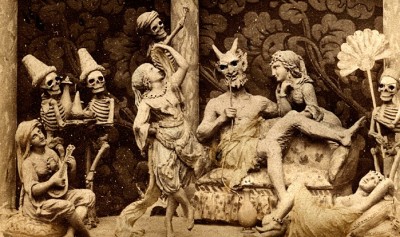
******************************************************************************************************************************** Brownstone Detectives investigates the history of our clients’ homes. The story you are about to read was composed from research conducted in the course of one of those investigations. Do you know the history of YOUR house? ******************************************************************************************************************************** If a man named Hell offered you some candy – would you take it? That was Otto Herman Hell’s problem. And, yes, in fact he was about to open a confectionery in Brooklyn on Broadway. THE DEVIL’S CONFECTIONER It must have been difficult growing up with a name like Hell. There were probably countless jokes and plays on the name. Otto must have been quite tired of it all by the time he reached the age of maturity, at which point he began thinking seriously about changing it. Having emigrated from Germany in 1891, he was 25 when the immigration officials must have looked up at him in surprise as he stood before them hoping to gain entry into the country. “Hell? Hell?” the official must have half-asked, half-shouted, incredulously. “O’Connor, come quick, or you’ll have Hell to pay!” Lots of uproarious laughter here, then a loud stamp, and then Hell was on to the next set of jokes somewhere in his new country. He probably found it curious in the early days, perhaps a bit enjoyable if he had had a playful streak. But, by George, it was 1911 now, and Otto was 36 with a wife and two children. He was more than ready to get serious with his […]
THE GANG THAT STOLE HOUSES (1907)
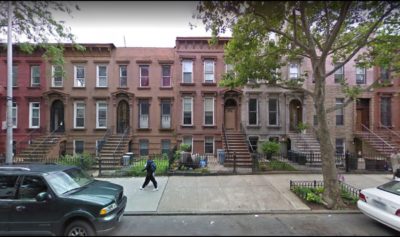
******************************************************************************************************************************** Brownstone Detectives investigates the history of our clients’ homes. The story you are about to read was composed from research conducted in the course of one of those investigations. Do you know the history of YOUR house? ******************************************************************************************************************************** Stealing homes is not a unique and recent invention. Known by its formal title as “deed fraud,” it involves the collusion of wrong-doers within and without city government. Cases of “deed forgery,” or of the filing of “bogus deeds,” have existed from the time that paper has been used to represent the transfer of property from one party to another. In the case of “deed fraud,” the difference between it and a regular legal real estate conveyance, is the fact that, in the former, someone else has represented themselves to be owner of a property they do not possess by forging their – or someone else’s – name on a document representing the parcel of property. The fraud continues when that document is notarized, sometimes illicitly on the part of the notary, and then filed with the city which represents that the victim’s parcel of property has now been transferred to someone else. The fraud, at this point is usually not complete, as the bogus transferer of the victim’s deed then transfers the victim’s property a time or two (or three) (through the hands of buyers who either have no idea their name has been used – or who happily allow their names to be used for a price) until the […]
THE GHOST OF 281 STUYVESANT AVENUE (1901)
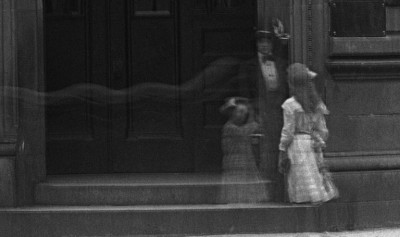
******************************************************************************************************************************** Brownstone Detectives investigates the history of our clients’ homes. The story you are about to read was composed from research conducted in the course of one of those investigations. Do you know the history of YOUR house? ******************************************************************************************************************************** “At last Stuyvesant Heights revels in the proud possession of a genuine haunted house.” This was back in 1901, when Stuy Heights was relatively young, the houses newish, and the ghosts scarce. But Stuyvesant Heights had everything back then – “a Republican Club, an amateur dramatic society,” and even “several asphalt streets where bashful maidens learn to wheel at night.” So why not a ghost? THE HAUNTING AT NO. 281 STUYVESANT AVENUE The Griffins, who had lived in the apartment house at the ground floor were terrorized by their electric bell ringing at 2 o’clock every afternoon. But they also heard “hollow groans,” “creepy sidesteps on the staircase,” and “unexpected trips from room to room of pieces of furniture.” It all got to be too much for the Griffins to handle, and so they fled. The Griffins moved to Williamsburgh. PERFECTLY GOOD EXPLANATIONS Some of the other tenants blamed the wind. A young woman who lived in the second floor apartment told an Eagle reporter that everything was perfectly explainable. “This house, you know, stands alone and the wind, when it sweeps into the vestibule, often comes hard enough to blow the whistle in the kitchen tube,” she explained. “Then it’s a fact that the pictures do move, but that’s caused […]
SHAKESPEARE AT NO. 24 BREVOORT PL (1928)
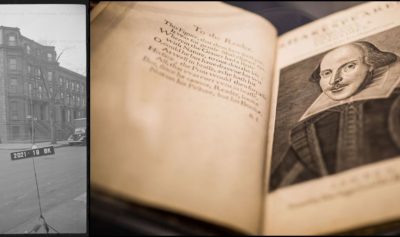
******************************************************************************************************************************** Brownstone Detectives investigates the history of its clients’ homes. The story you are about to read was composed from research conducted in the course of one of those investigations. ******************************************************************************************************************************** Henry C. Folger loved Shakespeare. His admiration for the author and his writings was such that he once paid $100K for a single folio of the bard’s work. The president of the Standard Oil Company was so smitten with Shakespeare’s works that, in 2014, a book, Collecting Shakespeare, was published about Folger and his collection. Folger, who started his relationship with Standard Oil as its director, would rise to become the chairman of its board, building a trusted relationship with the company’s owner, John D. Rockefeller, Sr. While frugal in the management of his money, Folger’s position with the largest oil company in the world certainly allowed him plenty of it to use in the pursuit of everything Shakespeare. And everything Shakespeare that he purchased for his collection eventually made its way to the library of their rented house at No. 24 Brevoort Place in Brooklyn, where the couple would live from 1910 through the early 1930s. FOLGER, BREVOORT, & SHAKESPEARE Henry Clay Folger’s collection of Shakespeareana included 35 copies of the 1623 first folio edition, of which only 200 copies were then known to be in existence. These earliest texts of William Shakespeare’s works were published during the 16th and 17th centuries in quarto or folio format. While quartos are smaller volumes, folios are large, tall volumes, roughly […]


