THREE MEN AND A PIG (1892)
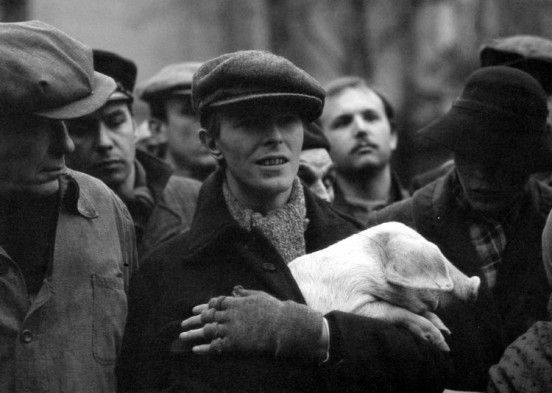
******************************************************************************************************************************** Brownstone Detectives investigates the history of our clients’ homes. The story you are about to read was composed from research conducted in the course of one of those investigations. Do you know the history of YOUR house? ******************************************************************************************************************************** (The setting of our story: The Eastern District of Brooklyn back in 1892 was a far more rural place that it is today. Comprised primarily of Williamsburg, Bushwick, and, parts of Stuyvesant Heights, the “E.D.,” as it was then called, was a semi-residential district filled with many small farmers living in frame houses and shanties, all of whom seemed to be living on the very edge of the world.) “Three men and a live, squeaking pig passed through Union avenue this morning.” The pig in the story “was an involuntary member of the quartet.” He was in the process of being stolen. “…(H)is shrill protests were heard by Policeman Farrington of the Nineteenth precinct, who traced the cries to the source. A man whom the policeman recognized as Thomas Farmer, Jr., of Union avenue and Frost street, was carrying a bag over his shoulder. “Farrington,” the story noted “gave chase and caught Farmer, who dropped the imprisoned pig on the sidewalk and showed flight. So desperate was his resistance that the officer was compelled to draw his club and a fierce fight of a few minutes’ duration terminated in the complete subjugation of Farmer.” Apparently, the two companions of the aptly named Farmer had fled. But they would not be gone […]
THE HISTORY IN YOUR BATHROOM WALL (1950)
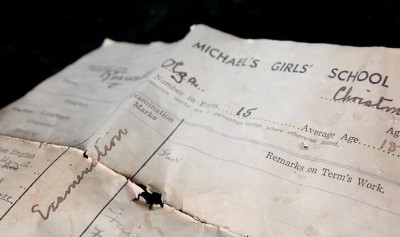
******************************************************************************************************************************** Brownstone Detectives investigates the history of our clients’ homes. The story you are about to read was composed from research conducted in the course of one of those investigations. Do you know the history of YOUR house? ******************************************************************************************************************************** Olga Roswell managed to receive “very poor” marks in her French class. She was “interested,” though, in Shakespeare, was “fair” in history, and she performed “fairly good” in mathematics. All of this academic patchiness, came to us from the St. Michael’s Girls’ School in Bridgetown, Barbados, via Olga’s “Christmas Term, 1950” report card. And this report card Olga managed to “conveniently” leave behind while she was visiting her Aunt Caroline in Brooklyn the following year. The report card, actually, fell out of the 2d floor bathroom wall during our extensive home renovations, and its discovery and associated story is now local lore and has become a treasured part of the history of our house at 738 Macon Street in Bedford-Stuyvesant. As such, the story has been featured in one of our Brownstone Detectives House History Books in the chapter about the family that owned the house. And Aunt Caroline’s former profession, unknown to us at the time, would soon become the missing piece of the puzzle that – once realized – caused everything to make sense. FINDING STACEY MAUPIN TORRES. Almost a year ago, as part of the work the Brownstone Detectives does in locating and interviewing former home owners and their descendants, we tracked down a descendant of James and […]
THE LURE OF A FEDDERS HOUSE (1902)
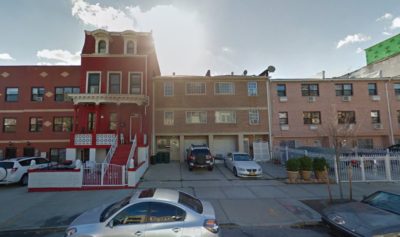
******************************************************************************************************************************** Brownstone Detectives investigates the history of our clients’ homes. The story you are about to read was composed from research conducted in the course of one of those investigations. Do you know the history of YOUR house? ******************************************************************************************************************************** (In 1868, Quincy Street [between Bedford and Nostrand avenues] boasted of rows of beautiful Victorian wood-frame homes. The row pictured above contained houses like the red building above.) In 1902, luxurious wood frame houses that had been built closer to the middle of the century before were beginning to show their wear – not just in their physical appearances, but also within the rental rolls that such structures had previously been able to command. Since 1868, when the above house (third from left) was built, brownstone and limestone fronted houses had come into vogue, attracting those with means to buy and rent them, while forcing owners of the antiquated frame houses, due to the old issue of supply and demand, to reduce their rents – significantly. “There is a row of three story frame houses on Quincy street, between Bedford and Nostrand avenues which illustrates the demand for houses with a modern style of front,” noted the Brooklyn Daily Eagle. “The Quincy street houses were built in 1868 by a well known architect and builder. They are 20 feet wide on an extra deep lot. The accompanying picture shows the appearance of the houses (no photograph was actually printed with this article). They sold for $9,000 each upon completion. Those who […]
THE BURGLAR WORE A SILK HAT (1892)
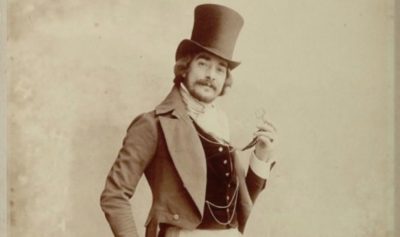
******************************************************************************************************************************** Brownstone Detectives investigates the history of our clients’ homes. The story you are about to read was composed from research conducted in the course of one of those investigations. Do you know the history of YOUR house? ******************************************************************************************************************************** “A burglar broke into the house of Martin Ficken, at 138 Van Buren Street, last night,” reported the the Brooklyn Daily Eagle on page six of its 8 February 1892 edition, “and carried off plated ware and clothing valued at $40.” The burglary must not have rattled Ficken’s faith in the neighborhood or the safety of his rented Stuyvesant Heights house, however, as two years later he would marry Frances Stillwell and she would move into the house to live with him there. Six years later, Ficken, a German-born grocer and veteran of the Civil War (he was a first sergeant of Troop F, Sixth New York Cavalry), would further signal his investment in Stuyvesant Heights when, in 1898, he, with Frances, purchased No. 138 Van Buren Street. The burglary must have at least caused Ficken wonder at the mental status of the burglar, though, as the newspaper further laid out not only what the burglar took – but what he left behind. “The thief,” the Daily Eagle continued, “took a derby hat from the rack and left in its place a new silk hat which was evidently too large for him, as a whole newspaper was folded and stuffed under the sweat lining.” Was the burglar prescient? Did he see […]
HOW TO ABANDON A BROWNSTONE (1907)
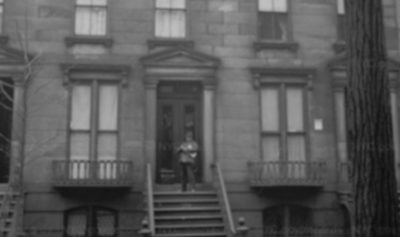
******************************************************************************************************************************** Brownstone Detectives investigates the history of our clients’ homes. The story you are about to read was composed from research conducted in the course of one of those investigations. Do you know the history of YOUR house? ******************************************************************************************************************************** The house at No. 178 State Street in Brooklyn Heights once sat untouched for almost 20 years. Owned by a woman in a sanitarium who was unable to utilize the property, she made all of her heirs promise – in 1889 – never to enter the house until she was dead. Apparently, though, they kept up appearances well in her absence by putting “help wanted” notices in the paper, and advertising “furnished rooms” in the house. The woman in question, Mrs. Mary J. Cooke King, according to her obituary, had been a leader during the Civil War in “arranging for the great fair held in Brooklyn in aid of the sanitary commission.” After she “came out of mourning” two years after her husband’s death “it was found she had developed an eccentricity of character bordering on insanity.” She “discharged all her servants; she had the windows and doors to her home iron barred and she refused to receive visitors.” The following piece appeared in the Brooklyn Daily Eagle shortly after she died, noting that the place could finally be placed on the chopping block. Obviously, none of her family wanted it. The story read: “The ‘house of mystery,’ at 178 State street, which was entered on Monday of last week for […]
IT’S RAINING CATS! HALLELUJAH! (1887)
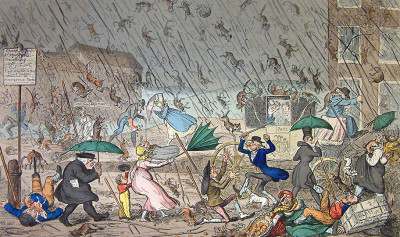
******************************************************************************************************************************** Brownstone Detectives investigates the history of our clients’ homes. The story you are about to read was composed from research conducted in the course of one of those investigations. Do you know the history of YOUR house? ******************************************************************************************************************************** It once rained cats on Grand Street. The felines were tossed and dropped rather dramatically from the rafters of a playhouse in Williamsburgh. When the Society For the Prevention of Cruelties to Animals got wind of the act, they decided to buy a ticket to the show, “Soap Bubble”… IT’S RAINING CATS…HALLELUJAH! In Williamsburg, in the late 1800s, there existed a show hall which sat in the middle of Grand Street between Bedford and Driggs avenues at No. 166. Known for a time as the Grand Street Museum, it had a run of only five years between 1885 and 1889. But the Museum made the papers in 1887, for a cruel cat storm that played out upon their boards… In the latter part of 1887, a show by the name of “Soap Bubble,” was making its debut in the district. Although it wasn’t creating much of a stir, it so happened that a letter about the show was received at the offices of the Society for the Prevention of Cruelty to Animals. The letter made a serious accusation, referring to “cruelty to cats” that was being “exhibited nightly” during the play. The writer, who noted he’d spent an evening at the theatre, stated that during the first act a “large number […]


