THE NOTORIOUS DRUNKEN POLLY WALTON (1880)
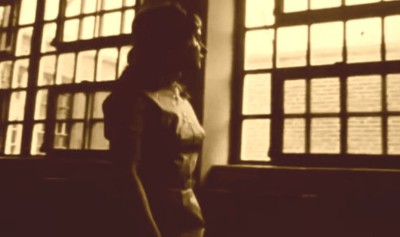
In 1879, alcoholism was practically a crime. And in many cases it was to be punished all the more severely in order that a change might be affected in its indulger. You either drank or you stopped drinking. There was precious little middle ground and relatively little pity for the alcoholic. THE CASE OF POLLY WALTON Polly Walton must have faced some difficult circumstances in her life, as she had at one time had everything – a life, a career, a husband, and two lovely daughters who had married well and were happy in their lives. For Polly, though, something had gone seriously wrong. After her husband died and her girls were married, her life had become a series of mornings awoken on the floors of jail cells, recovering from far too much alcohol and far too little memory of what had transpired the night before. Frequently in front of judges, she had gotten very good at promising them everything they wanted to hear. Polly, though, was referred to in the court system as “an old offender.” She was expected to be seen again and again, slowly moving in a downward spiral until one day she was no longer around – a faceless victim of crime which brought her to her last confinement – the city morgue. “Polly has spent at least nine-tenths of the past five years in prison as a penalty for her passion for strong drink,” so stated the Brooklyn Daily Eagle. HER DAYS IN COURT On […]
WHEN DID SOCKER COME TO BRUKLYN? (1907)
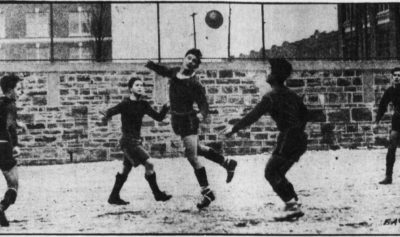
“Socker” wasn’t taken seriously in the U.S. at least until the 1950s or so. Well, I suppose “seriously” is a relative term, as some would say even today that the sport is still not given its fair due. A sport that is played by more people across the world than any other, it was eventually bound to take root in the U.S. With the number of immigrants in the greater New York City area it happened quicker than in other parts of the country. The game took root first at high school, colleges, and in social leagues throughout the city before it became a professional draw. The first mention of “soccer foot ball” in the Brooklyn Daily Eagle, was in 1899 in a story about an Orange Free State club traveling to the U.S. for an exposition. By 1907, there were signs that the game would take in Brooklyn as the Crescent A.C. Socker Team was founded. Crescent AC was the sole Brooklyn club for several years until other parts of the borough began fielding their own teams – such as the Montclair Athletic Club, the Bensonhurst Field Club, and the Staten Island C. & F. C. After this, as more teams were built and more and more Brooklynites were exposed to the game, the sport slowly discovered acceptance and, in some areas, even took on more of an air of respectability. Here are a few pics from down the ages. AMATEUR – 1907 SEMI-PRO – 1912 HIGH SCHOOL – […]
THE “BRIDGE & TUNNEL” CROWD (1903)
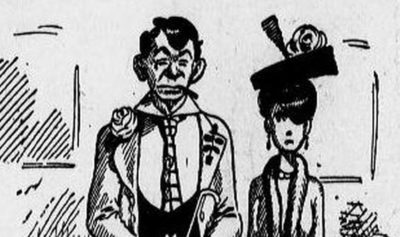
******************************************************************************************************************************** Brownstone Detectives investigates the history of our clients’ homes. The story you are about to read was composed from research conducted in the course of one of those investigations. Do you know the history of YOUR house? ******************************************************************************************************************************** In 1896, the “Bridge & Tunnel” hipster crowd took a giant leap forward. With the success of the Brooklyn Bridge – and its affect on the borough’s progress – long ago assured, construction on the Williamsburg Bridge had begun that year. Shortly after the bridge’s opening in 1903, though, the seriousness of the occasion passed, and the inevitable cartoons lampooning the “simple folk” of the outer boroughs would begin to appear. This cartoon was printed in The Evening World about a year after the opening – just long enough afterwards for the cartoonist – and everyone else who traveled the bridge on a regular basis – to have already become familiar with the “types” who crossed the bridge. It lampooned the “country mouse comes to the city” aspect of those suburbanites (rural dwellers, to those living in the city) from the outer borough of Brooklyn who were beginning at the time to patronize the offerings of the city through its novel and accessible rapid transit system. The cartoon also depicted the out-of-date dress and forced style of the Williamsburg “set.” Specifically, though, it represented the new access to the city that the commuters from the Eastern District of Brooklyn (read Williamsburg) then enjoyed due to the recent addition of the new […]
TRAPPED IN A BILLYBURG FREEZER (1902)
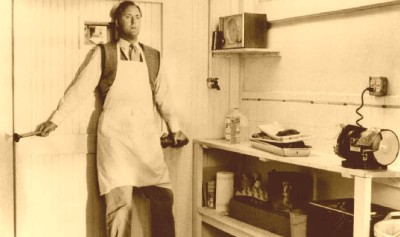
******************************************************************************************************************************** Brownstone Detectives investigates the history of our clients’ homes. The story you are about to read was composed from research conducted in the course of one of those investigations. Do you know the history of YOUR house? ******************************************************************************************************************************** If you stepped into a walk-in freezer and the door slammed shut on you – how long do you think you could hold out? In this day and age, such a scenario certainly plays itself out on the mental movie screen anytime we step into one. Such accidents happened enough that the freezer companies began to make safety locks allowing those trapped so to be able to escape without outside assistance. Back in 1902, however, you were – literally – on your own. THE SALOON AT GRAND AND GRAHAM H.H. Myers, a German saloon keeper, had moved recently from Manhattan to Brooklyn to open up a new saloon in the Dutch Town section of Williamsburg at Grand Street and Graham avenues. In his new place he “had things so arranged that he kept his beer barrels in an ice box in the cellar. One Saturday night in 1902, Myers had a thirsty crowd about the place, “all of whom were demanding more beer.” When one keg went dry, Myers descended his cellar stairs and entered the ice box to “put on” a new one. Myers had his set up such that the pipes leading from the beer taps behind his bar led down to the ice box in the cellar, where […]
A PROHIBITION WRECK ON ORANGE ST (1922)
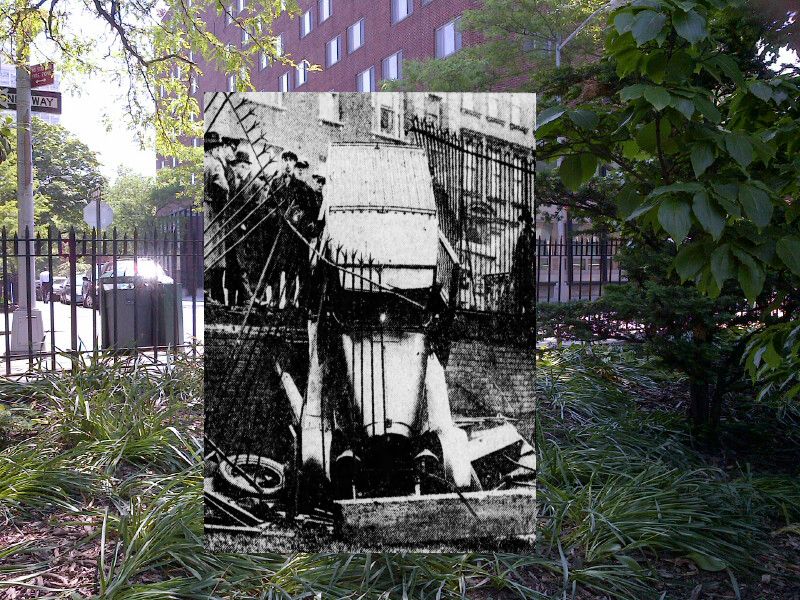
******************************************************************************************************************************** Brownstone Detectives investigates the history of our clients’ homes. The story you are about to read was composed from research conducted in the course of one of those investigations. Do you know the history of YOUR house? ******************************************************************************************************************************** “Tearing through Orange st. with the throttle wide open, in the early hours this morning, a big limousine of expensive make crashed into an electric light pole at the foot of the street, ricocheted against a fire hydrant which it completely demolished, continued on its course and crashed through an eight-foot picket fence.” A flirtation at a dance, a stolen vehicle, a crash, the removal of a set of license plates, and a hasty departure from the scene of the accident was further described in the 12 December 1922 newspaper article. “CRASH WAKENS HEIGHTS” “A blood-stained hand pushed open the door of the limousine. Two gory men stepped out,” wrote the reporter. The two men “then turned and assisted a woman out of the car. They climbed over the wall to the street and stood huddled in a little group as if debating what to do.” After a few minutes of dazed waiting, the three crash victims walked quickly up Orange Street. Then, a few minutes later, one of the men was observed returning and making “a vain effort to wrench the rear license plate from the car.” All that he succeeded in doing, though, was leaving “a number of bloody but well-defined fingerprints on the license number.” A WOMAN APPEARS […]
WHALE HUNTING AT THE NAVY YARD (1887)
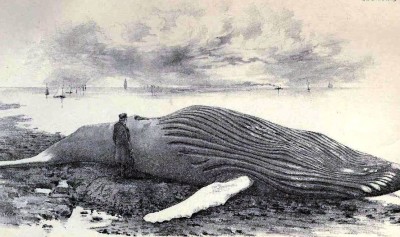
******************************************************************************************************************************** Brownstone Detectives investigates the history of our clients’ homes. The story you are about to read was composed from research conducted in the course of one of those investigations. Do you know the history of YOUR house? ******************************************************************************************************************************** When the Navy Yard sailors spotted the mass floating in the mill pond-like waters of the Wallabout Bay they could hardly believe their eyes. Never had anyone before seen a fish of this size enter the Navy Yard’s Whitney Basin, let alone a gargantuan the size of this whale. Old-timers had talked about the ones they’d hunted, going on about their supreme strength and how dangerous a prey they had been to hunt. Everyone watching braced themselves for the inevitable feats of strength it was preparing to perform. No noise nor movement, however, emitted from the beast. This whale’s attitude seemed to be comparable to the peaceful musings of a cat with a ball of yarn. “It was a big black whale forty feet long,” the papers noted, and it floated listlessly near the entry of the Whitney Basin. As a great crowd gathered to watch the monstrous fish, it was quickly decided to “man one of the old whale boats to capture the monster.” Many a Starbuck was born that day, as the sailors raced to prepare the rigging and launch their craft. But something was wrong – something just didn’t seem right with the beast. It was at that point an old sailor with “a keen olfactory organ caught […]


