PAINTING THE HUDSON AT No. 75 ST. JAMES PL
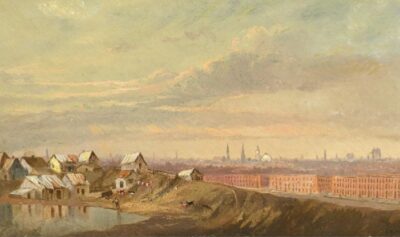
******************************************************************************************************************************** Brownstone Detectives investigates the history of our clients’ homes. The story you are about to read was composed from research conducted in the course of one of those investigations. Do you know the history of YOUR house? ******************************************************************************************************************************** Charles Day Hunt was a talented landscape painter whose work pivoted between the naturalism of the Hudson River School and the expressionism of the Tonalists. Born in Detroit, Michigan, in 1840, he eventually settled in Brooklyn, New York, around 1858 and trained under the landscape painters of the day: John F. Kensett and Alexander Wyant. Hunt’s exhibitions of oil and water color works took place from his studio at No. 75 St. James Place in Clinton Hill section of Brooklyn. Hunt’s work seamlessly blends the influences of both of his mentors in an individual style of crisp brilliance and atmospheric moodiness. Beginning in 1866 going through 1886, Hunt exhibited many times at The National Academy of Art & Design and The Brooklyn Academy of Art. He gained prominence as a member of The Black & White Club, which was a private American art association. Hunt died in 1914 in Brooklyn where, in his studio, his funeral was held. The body lay “beside the empty studio chair, pulled up before the easel,” noted the Brooklyn Daily Eagle, “on which was the picture Mr. Hunt had been working on before his seizure; the palette and oil colors were still wet.” Today, his works can be found in private and public collections, including The Brooklyn Museum […]
THE NIMBY FENCES OF COBBLE HILL (1900)
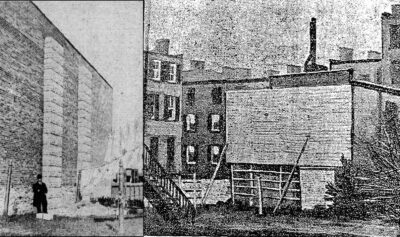
******************************************************************************************************************************** Brownstone Detectives investigates the history of our clients’ homes. The story you are about to read was composed from research conducted in the course of one of those investigations. Do you know the history of YOUR house? ******************************************************************************************************************************** “Good fences makes good neighbors.” So goes the line in Robert Frost’s poem, “Mending Wall,” which refers to the barriers people put up between themselves and others. It was also a saying favored by flinty new England farmers who thought it wise to keep their cows from straying into neighbors’ yards. When those fences ran higher than 10 feet and blocked their neighbor’s light and air, however, they tended to generate the opposite reaction – hostility. EXCHANGING HORSE NEIGHBORS FOR PEOPLE NEIGHBORS In the 19th century, Cobble Hill’s Verandah Place was a well-kept private alley within which the owners of the “mansions” on Congress and Warren Streets maintained carriage houses. When public transportation improved in the city, those horses became redundant for some. Thus, these carriage houses began to be sold to investors who, in turn, converted them, one by one, into “tenement houses.” Soon afterwards, however, the owners of these luxurious mansions abutting this alley no longer experienced the peaceful and rustic sound of the neighing of horses. They were now confronted with “squalid” tenements that attracted “far from choice” tenants. Thus, a class war had begun and those with the most means were, characteristically, intent on winning it. Faced with this new reality, the mansion owners felt that they […]
BURGLAR-ON-A-SHELF, No. 1141 DEAN ST (1911)
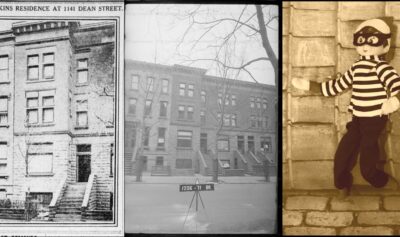
******************************************************************************************************************************** Brownstone Detectives investigates the history of our clients’ homes. The story you are about to read was composed from research conducted in the course of one of those investigations. Do you know the history of YOUR house? ******************************************************************************************************************************** Nearly a month after Christmas of 1910, a daring brownstone burglary occurred. (Or, at least, it was thought to have come to pass.) The incident took place in a fashionable neighborhood of Brooklyn – where such acts are rarely mentioned (outside of the servants). The burglar was never discovered, although a large number of police reserves and detectives had responded to the call and combed the house and the neighborhood. The police never solved the crime – nor did they even prove that it had ever taken place. But their presence on the upper-crust street caused quite the hubbub where many upstanding residents lived – many of whom feared their residence would be the next target. NOW YOU SEE ME, NOW YOU DON’T “The police of the Grand avenue station are to-day stil investigating the circumstance surrounding the calling out of the reserves and detectives to 1141 Dean street, the residence of J. C. Hipkins,” noted the Brooklyn Daily Eagle on 21 January 1911. Hipkins, whose full name was John Clifton Hipkins, was an insurance broker who lived in a “fashionable” neighborhood, the residents of which, the Eagle said, were “still agitated over the occurrence, which transpired about 5 o’clock Thursday afternoon. “The Hipkins residence,” the paper continued, “is just across […]
WOMAN ON A LEDGE AT No. 97 MACON ST (1953)
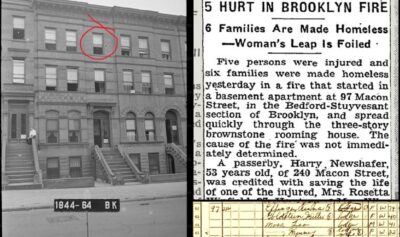
******************************************************************************************************************************** Brownstone Detectives investigates the history of our clients’ homes. The story you are about to read was composed from research conducted in the course of one of those investigations. Do you know the history of YOUR house? ******************************************************************************************************************************** All houses have a history. Those of a certain age clearly have it in spades. One part of any house’s history are those incidents that occur without planning or preordination. They can be unpleasant to know. One of those unplanned incidents, is the housefire of unknown origin that spreads uncontrollably through a residence. One such fire which spread throughout a building, took place on a cold January day in 1953 in a rooming house on Bedford-Stuyvesant’s No. 97 Macon Street. FROM A SINGLE-FAMILY TO A ROOMING HOUSE By 1953, Bedford-Stuyvesant’s brownstone stock was ageing – and it was not doing so gracefully. A large percentage of this section of Brooklyn’s brownstones had passed their semicentennial and were still wired and plumbed as they had been when they were constructed. While many of them had been maintained through the first 30-40 years, as earlier owners moved out and were acquired by owners who began to rent out rooms, however, these newer owners put little money into their maintenance, preferring to squeeze as much profit as possible out of their rent rolls. The Depression-era programs of redlining and blockbusting brought many unsavory characters into the business of making money through the purchase and management of brownstones in black-majority sections – as well as […]
No. 2 EAST 75th ST, UES: A BRIEF HISTORY
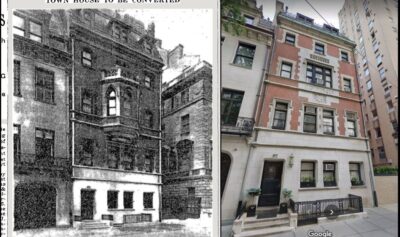
******************************************************************************************************************************** Brownstone Detectives investigates the history of our clients’ homes. The story you are about to read was composed from research conducted in the course of one of those investigations. Do you know the history of YOUR house? ******************************************************************************************************************************** “Hoyt House Sold for Apartments” ran the title of the New York Times articles on Fri., 21 February 1941. “The purchase of a large East Side residence and plans for converting it into an apartment building of small suites were announced yesterday when Albert Klein bought the five-story dwelling at 2 East Seventy-fifth Street from the Hoyt Estate. “The house occupies a lot 30 by 102.2 feet, adjoining the southeast corner of Fifth Avenue, and was sold through Douglas L. Elliman & Co., brokers. The adjoining residence at 934 Fifth Avenue was formerly the home of Charles E. Mitchell, who bought it from the estate of A. M. Hoyt through the Elliman organization. Thomas J. Watson, president of the International Business Machines Corporation, recently bought 4 East Seventy-fifth Street.” According to the Upper East Side Historic Designation Report, No. 2 is a neo-French Classic with Tudor detailing style home was built in 1893-95 by Richard H. Hunt for Henry R. Hoyt. A rear addition was added in 1907, a new limestone façade at the foundation wall in 1910, and a rear penthouse in 1919. It is not clear whether it was during the 1941 conversion that the large and distinctive bay window extension on the front of the building was removed. […]
No. 4 EAST 78th ST, UES: A BRIEF HISTORY
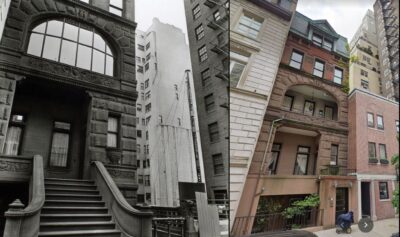
******************************************************************************************************************************** Brownstone Detectives investigates the history of our clients’ homes. The story you are about to read was composed from research conducted in the course of one of those investigations. Do you know the history of YOUR house? ******************************************************************************************************************************** According to Christopher Gray’s Streetscapes: Reader’s Questions, of the New York Times, No. 4 East 78th Street, is a Queen Anne-style house “built in 188 by the developer-architect Edward Kilpatrick. Upon completion, Kilpatrick sold it to the family of Arnold Falk, then living in a rowhouse at 129 East 64th. Mr. Falk was in the tobacco business on Water Street with his brother, Gustav, who lived in an adjacent house, 131 East 64th. On East 78th, Mr. Falk lived with his wife, Fannie, their two children and four servants. In the 1910’s and the 1920’s the house was occupied by the family of Jacob Dreicer, a principal in the Dreicer & Company jewelry firm founded in 1869, which was prominent in this period. There are now seven apartments in the building.” (New York Times, Sunday, 2 June 1991) Follow @BrownstoneDetec Share ———————————————————————————————————————– The Brownstone Detectives Brownstone Detectives is an historic property research agency. Our mission is to document and save the histories of our clients’ homes. From our research, we produce our celebrated House History Books and House History Reports. Contact us today to begin discovering the history of your home.


