YOUR BROWNSTONE WAS NOT BUILT IN 1899
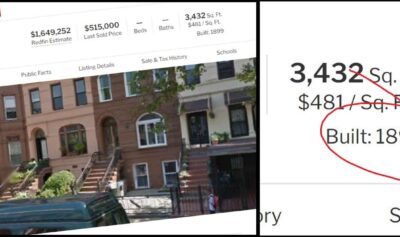
******************************************************************************************************************************** Brownstone Detectives investigates the history of our clients’ homes. The story you are about to read was composed from research conducted in the course of one of those investigations. Do you know the history of YOUR house? ******************************************************************************************************************************** We’ve all “Googled” ourselves, right? But have you ever Googled your house? Most people do this out of curiosity – just to see what might pop up. If you’ve ever done it, though, you were likely greeted with an extensive list of real estate sites that literally entreated you to click their links. Click on one of them and you may be surprised at what you find. Apparently, using their fancy algorithms, these sites can tell you nearly every detail under the sun about your property. These details include: the number of stories your house has, how many units are inside, the legal type of building it is, the district it lies within, its floor plans, the name of its neighborhood, its estimated value, various documents and permits filed, past sales, rental – and the list goes on and on… You may possibly even see images of the exterior of your rowhouse, as well as numerous snapshots of the inside (likely from a previous sale). For the most part you may note that everything – so far as you can tell – is relatively correct. There is, however, one very important piece of information that, on 99% of informational listings (including yours), is dead wrong… “BUILT IN 1899”? Why does nearly […]
“DR. SEUSS” ON A CLINTON HILL BROWNSTONE
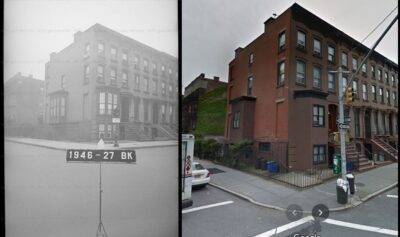
******************************************************************************************************************************** Brownstone Detectives investigates the history of our clients’ homes. The story you are about to read was composed from research conducted in the course of one of those investigations. ******************************************************************************************************************************** What happened here, It is not clear. Some window bays Have lost their glaze. I wonder why They had to nix it. For it wern’t broke, So t’wern’t to fix it. – Dr. Seuss, on the bay windows of No. 280 Lafayette Ave, Clinton Hill, Brooklyn. Follow @BrownstoneDetec Share ———————————————————————————————————————– The Brownstone Detectives Brownstone Detectives is a property research agency. Our mission is to research, document, and save the histories of our clients’ historic properties. From this research, we produce our celebrated House History Books. Each book is fully cited, featuring detailed narratives and colorful graphics, and is designed to bring the history of any house to life. Contact us today to begin discovering the history of your home.
THE PLAN TO SEGREGATE BED-STUY (1937)
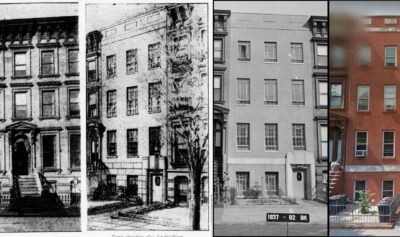
******************************************************************************************************************************** Brownstone Detectives investigates the history of our clients’ homes. The story you are about to read was composed from research conducted in the course of one of those investigations. Do you know the history of YOUR house? ******************************************************************************************************************************** In 1937, much of Brooklyn’s brownstone stock was reaching its limits. Its townhouses were, on average, approximately 50 years old and, in the eyes of many residents and brokers, outmoded of interior and unattractive of exterior. In fact, residents of certain sections of Brooklyn were beginning to move out of the older sections with the ancient brownstones, in favor of the newly constructed apartment buildings – or simply to other outlying sections of the borough. There were those residents, however, who felt that they saw a bigger problem, an over-arching trend that, unchecked, had the potential to destroy investment, send house values spiraling downward, and force them to move out of a community where they – and their families – had lived for generations. For these residents, the problem fell less into the category of an ageing housing stock than into that of the lot of outsiders – those of a different economic class, certainly those of a different race – who were already beginning to move into them. The problem of the outdated housing stock, while real, was not the sole impetus to modernize. Rather, that incentive came from a fear of an undesirable population that must, at all costs, be kept at bay. It was, thus, that a move […]
HOW TO MOVE A ROW OF BROWNSTONES (1905)
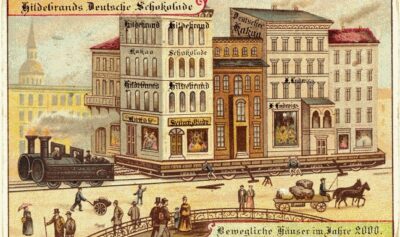
******************************************************************************************************************************** Brownstone Detectives investigates the history of our clients’ homes. The story you are about to read was composed from research conducted in the course of one of those investigations. Do you know the history of YOUR house? ******************************************************************************************************************************** It was called “one of the most unusual examples of housemoving” ever. Up until 1905, no one had ever attempted it. And it was moving two rows of five Brooklyn brownstone houses together, as a row each, one, across the street, and one across a block AND a street. Contractors, experienced in the business, had – to this point – only moved much lighter frame houses, even rows of frame house. But a row of brownstone houses? Impossible! Over a course of several weeks, though, two rows of brownstone houses were jacked up, stabilized – and then rolled away. These same brownstone houses now sit across the street on Jefferson Avenue – as though they had always been there. MAKING WAY FOR THE EXTENSION It all started in the Bedford-Stuyvesant section of Brooklyn, when the State of New York decided it needed more room for an extension to an armory it owned on Sumner Avenue. The armory, bound by Sumner Avenue on the west, Putnam Avenue on the north, and Jefferson avenue on the south, could only expand in one way – into two rows of brownstones. Behind the armory, on Putnam Avenue, sat a row of brownstones from the 1880s, while, on Jefferson Avenue, a more recent vintage of brownstones […]
HAS YOUR BROWNSTONE BEEN BURGLED? (1881)
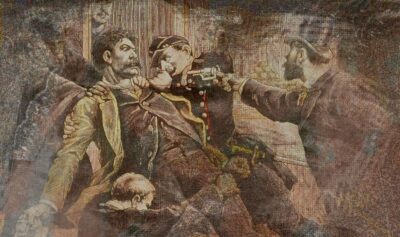
******************************************************************************************************************************** Brownstone Detectives investigates the history of our clients’ homes. The story you are about to read was composed from research conducted in the course of one of those investigations. Do you know the history of YOUR house? ******************************************************************************************************************************** New York City brownstones are veritable repositories of History. For many owners of these august “brownstone-fronts,” their homes are undoubtedly amongst the quintessential vessels within which their collective past has accrued – and has infrequently been recorded (if recalled). Ironically, it is the relatively transient nature of our brownstones’ owners (the median period of ownership of a brownstone is 15 years) that causes this history to become scattered to the ages – as one family moves out and a new family takes title to the home. Thus, with each changing of the guards, a fresh new forward-looking history begins. The “disappearance” of this history, however, serves to shackle any lineage of owners that exists, causing a sort of historical amnesia that allows your home to compare meanly with similar others in your neighborhood (esp. when placing a value on your home – or putting it up for sale). SAVING YOUR BROWNSTONE’S CRIMINAL HISTORY? Most burglaries throughout New York City history, we can be certain, have gone unreported. While most of those that do reach the attention of the police, never make it in into the papers, there are a goodly percentage of burglaries, however, that were not only reported to the police but received vivid and colorful coverage – unwanted as […]
THE RAREBIT FIEND OF 23 MIDDAGH ST (1906)
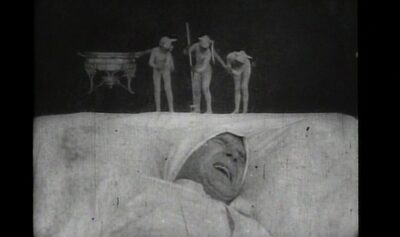
******************************************************************************************************************************** Brownstone Detectives investigates the history of our clients’ homes. The story you are about to read was composed from research conducted in the course of one of those investigations. Do you know the history of YOUR house? ******************************************************************************************************************************** At No. 23 Middagh Street in Brooklyn Heights, in the early 20th century, lived the veteran actor, John P. “Jack” Brawn, who starred in upwards of 24 motion pictures. Most notably, he starred in the first ever trick motion picture, 1906’s “The Dream of a Rarebit Fiend.” Brawn lived on Middagh with his wife, Ethel Brooke Ferguson, who had been his leading lady on stage and whom he married in 1903. THE DREAM A trippy movie, “The Dream of a Rarebit Fiend” is about a man, played by John P. Brawn, the titular “fiend,” who has an all-too-real dream after consuming a large meal of Welsh Rarebit. His dream, rather a nightmare – the result of an upset stomach, the film implies – was likely supposed to represent the penance that could expect to be paid for the sin of gluttony connected with living a life of overabundance. The director of the short film, Edwin S. Porter, based the film on a comic strip, using it as a vehicle to present his mastery of the technical aspects of film-making, which displayed a good deal of hands-on special effects work – double exposures, miniatures and other camera trickery. Few cinema-goers, it is certain, would have seen a picture like this at the time. […]


