THE FIRE AT NO. 382 PARK PLACE (1903)
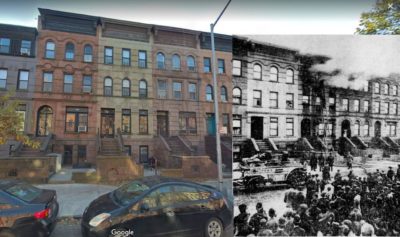
******************************************************************************************************************************** Brownstone Detectives investigates the history of our clients’ homes. The story you are about to read was composed from research conducted in the course of one of those investigations. Do you know the history of YOUR house? ******************************************************************************************************************************** All new homeowners begin their “home” journey with a blank slate. This is especially true in the case of owners of very old properties. They have very little information about the history of the structure they will be living in and nothing at all about the people who once lived there. When we meet with clients for the first time and reveal an important historical event involving their house, they begin to realize a very important historical tenet: Each house has a history. For one house, that history may include a tale about a runaway child. For another it could be a bankruptcy that led to a foreclosure on the home, followed by the family’s ignominious departure in the wee hours. For yet another, it may be a fire that almost destroyed the entire house that they had just purchased. For No. 382 Park Place, it was the flames. “THE FIRE CAUSED MUCH EXCITEMENT…” In a newspaper article accompanied by a picture of the firemen fighting the conflagration, the known details were spelled out – from the person who was home to how the fire was reported and what damage was done. “Fire broke out late yesterday afternoon in the house at 382 Park place and the work of the firemen […]
THE SKY BLUE CEILINGS OF 121 HENRY ST (1889)
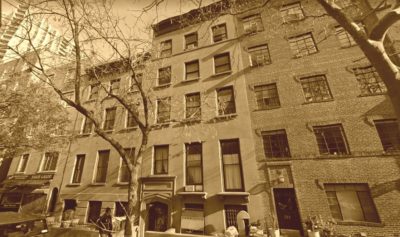
******************************************************************************************************************************** Brownstone Detectives investigates the history of our clients’ homes. The story you are about to read was composed from research conducted in the course of one of those investigations. Do you know the history of YOUR house? ******************************************************************************************************************************** In the late 1880s, the Brooklyn Daily Eagle started a series of articles which described – in great length and detail – the interiors of individual newly-built or renovated houses. These houses were usually brownstones belonging to those affluent or upper-middle-class members of society. Not only did such articles describing the interiors of neighbors’ homes sell newspapers, but the articles also served as advertising directed at those in the market for a townhouse to have a home of their own. These advertisement-articles were placed, likely at the expense of the designers responsible for the “interior decorations” being described, as each piece often ended with what readers wanted to know. “Who did the work?” WORK IS BY JOHANSMEYER & KOENKE, NEW YORK The “three story brown stone residence,” at “121 Henry street, near Clark,” was owned by Henry L. Meyer, who – at the time – was a hotel keeper, but who would rise to the position of treasurer of the Consumers Brewing Company. Meyer lived in the house with his wife and two daughters. In 1889, Meyer, who had recently acquired the (what until then had been used as a) rooming house, embarked upon a whole-house renovation, employing the New York City designers Johansmeyer & Koenke. Theodore C. Johanesmeyer and Bernhard […]
“THINGS GIRLS LIKE TO DO…” (1917)
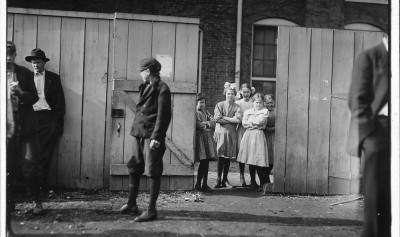
******************************************************************************************************************************** Brownstone Detectives investigates the history of our clients’ homes. The story you are about to read was composed from research conducted in the course of one of those investigations. Do you know the history of YOUR house? ******************************************************************************************************************************** “In a kitchen where there is no sink, the substitute should be a steady table.” “Try to clean only as much each day as can be can be put back into habitable order by the time the men of the household come home.” “I cannot vouch for Plaster of Paris, but I can for corn meal and flour, for with it I once successfully cleaned a white kitten.” Such are some of the excepts of “Things Girls Like to Do,” a manual on domestic work for the young lady of 1917, which today is a window into the maintenance of a household 100 years in the past. The world of domesticity in the late nineteenth and early twentieth century was changing rapidly, as indoor plumbing came into being and electricity introduced into the home. And so the “women’s work” of the household necessitated convenient instruction for girls who would some day take on the sole responsibility of “keeping house.” “Things Girls Like to Do” was that little primer for that period. Of more interest today to those maintaining historic homes, it gives loads of specific insight into how today’s old houses were initially kept up. From the use of burnt pine ash for polishing copper, to the extensive use of calcimine […]
WERE THESE BROOKLYN’S FIRST CO-OPS? (1899)
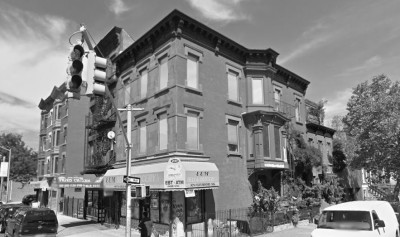
******************************************************************************************************************************** Brownstone Detectives investigates the history of our clients’ homes. The story you are about to read was composed from research conducted in the course of one of those investigations. Do you know the history of YOUR house? ******************************************************************************************************************************** Back in 1899, Bolton Hall, the son-in-law of lawyer and real estate investor, William H. Scott, convinced Scott to allow him to use some of his real estate units to experiment with a “novel co-operative idea.” “Mr. Hall’s idea was simply to let tenants share the profits of the property they occupied,” noted the New-York Tribune. “Previous to April, this year, Mr. Scott was the owner of houses at Nos. 231, 223, 225, 219, and 221 Reid-ave., Brooklyn. The property lies between Hancock st. and Jefferson ave., and consists of three single and two double houses.” Hall, who would spend his life working on behalf of the poor, had started the “back-to-the-land movement” in the United States at the time, which was a forerunner of the Green Thumb project and consisted of encouraging people to begin gardens on vacant lots. Hall noted that the tenants of the buildings eagerly entered the scheme and that during a 4-month period the plan was successful. Hall told the tenants that it was proposed to value the buildings at ten times their proper rent when full, which would be $8,000 each for the single houses and $14,000 for the double,” noted the New York Times, “and to reserve as Mr. Scott’s share 5 per cent. […]
THE “SPITE WALL” OF CALDERVILLE (1919)
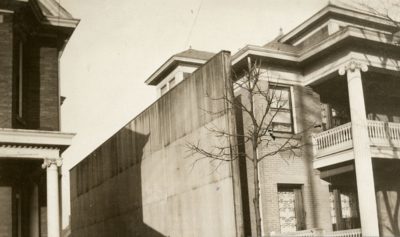
******************************************************************************************************************************** Brownstone Detectives investigates the history of our clients’ homes. The story you are about to read was composed from research conducted in the course of one of those investigations. Do you know the history of YOUR house? ******************************************************************************************************************************** We have all heard of the “spite house.” It is a type of building – constructed on an impossibly small piece of land – existing for a single purpose. That purpose? Spite. In 1919, Marcus Siegelman produced a variation on this theme. He built a spite “wall.” BAD WALLS MAKE BAD NEIGHBORS Sitting in his backyard one day, Siegelman watched as two holes began to appear through the brick wall at the end of his yard. That brick wall was the side of his neighbor’s house, and those holes were about 15 feet up from ground level. Small at first, they eventually grew to the shapes of a couple of large rectangles. Siegelman immediately had his suspicions, but he waited to see what would happen. Slowly, after they were made perfectly squared, into the new openings were installed a couple of sash windows. Siegelman, who lived at No. 1627 10th Avenue in what was known at the time as Calderville (but is referred to today as Windsor Terrace), was now suddenly at war with his neighbor, E. L. Morris, a former policeman who lived at No. 192 Windsor Place (the house behind his with the new windows). For Morris now had a perfect view into Siegelman’s backyard – and his home. […]
A RAILROAD FOR PARK SLOPE’S 8TH ST. (1904)
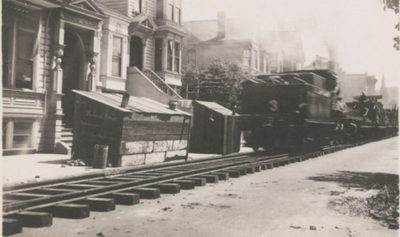
******************************************************************************************************************************** Brownstone Detectives investigates the history of our clients’ homes. The story you are about to read was composed from research conducted in the course of one of those investigations. Do you know the history of YOUR house? ******************************************************************************************************************************** Few of today’s Park Slope residents know about them. In early February of 1904, however, they suddenly appeared on Eighth Street between Prospect Park West and Eighth Avenue, an industrial omen in a white shoe neighborhood. These dark and foreign objects were a set of iron railroad tracks that had been – overnight – inserted coarsely into a place where they did not belong – residential suburbia. The block where these alien metals and wood had descended, had just barely been settled recently with homes (and even more recently with families). It had just seen itself partially developed with a row of eight upscale apartment houses on the north side of the street and 12 two-story & basement limestone houses on its south. With the recent spate of construction, there were – at the time the tracks appeared – a mere four families that had purchased “handsome houses” on the block, which they had taken possession of at “fancy prices.” Now, those with an interest on the block were showing “great alarm.” With the appearance of the tracks, residents fully expected their properties to be “ruined in value,” causing them to begin considering selling them at a discount and to ignominiously leaving the neighborhood. The builder of the limestones, Sen. William […]


