The Campfire Girl & The Marxist, Pt. II (1915)
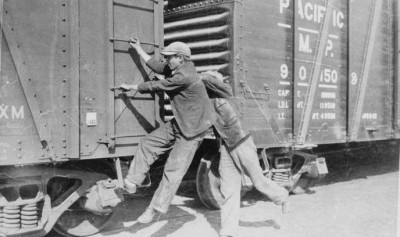
(And now, the thrilling conclusion of – “The Campfire Girl & The Marxist.”) THE ESCAPE PLAN The escape plan seemed so simple in its design that it was later wondered how it ever worked. Although the overall scheme of hopping freight trains headed west was plotted intimately with maps and the help of encyclopedias, the actual disguise plans and methods for eluding authorities was rather, well, sophomoric. But it worked. It seems that Max went down to a store on Fulton street, and there bought for Viola a pair of brown knickerbockers, a Norfolk jacket and a gray cap with a peak on it like a bicycle cap. Viola would look like a boy bicyclist. “He just guessed at the measurements,” said Bostick, adding with a knowing grin, “and I must say Max was a fine guesser.” When Max, Viola, and Andrew arrived at the Kowenhoven station of the Long Island Rail Road – for Andrew was an accomplice in their escape – Max made a suggestion that must have rankled Viola – that, to aid in their escape, she could roll her hair up and hide it under her cap. Viola, however, was having none of that. If she was going to be a boy, she was going to go the distance. She stated firmly that she wanted her curly locks shorn completely. So, there, under the archway of a railroad bridge, Max snipped off six “curls.” He kept three, bound in a handkerchief, and gave three of them […]
The Campfire Girl & The Marxist (1915)
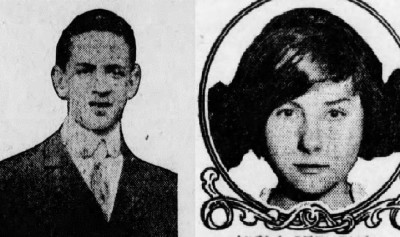
******************************************************************************************************************************** Brownstone Detectives investigates the history of our clients’ homes. The story you are about to read was composed from research conducted in the course of one of those investigations. Do you know the history of YOUR house? ******************************************************************************************************************************** If nature were a fair goddess, she would have made some girls boys and some boys girls. Although most teenagers often go into their young adulthood trying to determine just who they are, some know it instinctively and early on from experiences that leave indelible etchings upon their souls. Viola Stevens was just such a girl. Although she was new to Hancock Street – and a bit serious for her years – she had initially proved herself to be very much like all of the other girls on the block. She loved nature, had boy “friends,” was a Campfire Girl, and had even, after some time, became a Woodcraft Girl. In other words, she spent nearly all of her 15 years doing “girl” things. In 1915, though, all of that changed when she did a very “boy” thing, which terrified her mother and excited the entire borough. She ran away – with a socialist. A MOTHER’S POINT OF VIEW No, of course. The “running away” bit was the actual catastrophe as far as her mother was concerned. The fact that the boy was a socialist simply added some salt to the wound. Any mother would tell you that her daughter is her world and that she is pure as the driven […]
BANNING NEW YORK’S ASSAULT WEAPONS (1926)
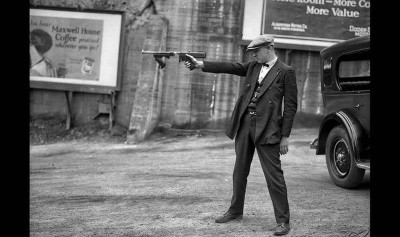
******************************************************************************************************************************** Brownstone Detectives investigates the history of our clients’ homes. The story you are about to read was composed from research conducted in the course of one of those investigations. Do you know the history of YOUR house? ******************************************************************************************************************************** Back during the Roaring ’20s, there was an assault weapon on every corner – or at least that was how it seemed. New York began to see the widespread use during these years of “Tommy” guns (machine guns), and sawed-off shotguns, which were freely available and useful in committing the crimes that joined the Mafia and Prohibition at the hip. A manager in the gun department of “one of the most conservative and long-established sporting goods stores” in New York City, Schoverling, Daly & Gales, noted that these types of weapons were sold without the necessity of a permit. “Although any well-established and reliable concern would take the same precautions that we do to see that these weapons do not get into the wrong hands, there are hundreds of fly-by-night small stores throughout the city where these things are sold without a permit and without any precaution except to get the price,” noted this gun salesman. Officials of the time were clearly aiming at protecting the public with their proposed weapons bans of the period, especially where it involved “inter-gang warring.” “The light Thompson sub-automatic…can be had in a number of stores on payment of the price – $500,” said the Brooklyn Daily Eagle. “A citizen who wishes to have a […]
THE SECOND HUMILIATION OF WARREN (1960)
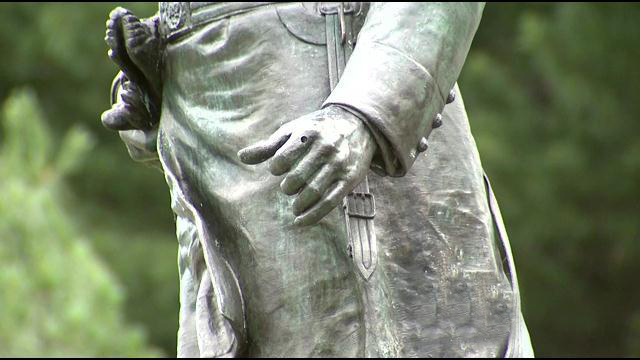
A number of New York City Parks Department statues are having their stolen swords replaced reported a DNAInfo story. The statues, most of which have had their their swords stolen (bayonets, and glasses, in some instances) during times of high crime, are now deemed worthy of replicas being cast. The Parks Department worries less now about the replicas being stolen themselves. I’ve often noticed one such statue in particular – the Kemble Warren statue at the Grand Army Plaza. First of all, why was it there? What had Warren, an engineer, done that could have been so critical to the war effort? Had he been a critical part of the attack at any actual battle? I figured that, as an engineer, he had – more likely – prepared a defense. But was that enough to receive a statue? KEMBLE WARREN – A HUMILIATION Gouverneur Kemble Warren, the engineer for whom the statue at the Grand Army Plaza had been cast and dedicated, had been known for his heroism at Gettysburg. By the time that General Philip Sheridan had begun his “burning of the Shenandoah Valley,” though, Warren had been castigated by, what Sheridan referred to as, a critical slowness in arriving to a certain battle. Because of this, Warren had been relived of duty by the general (an action supported by General Grant, at the time) and assigned to another, less critical, theater of battle. The humiliation of the relief of command, though, had already had its effect. After some […]
WHAT EVIL LURKS AT No. 666 MACON? (1903)
******************************************************************************************************************************** Brownstone Detectives investigates the history of our clients’ homes. The story you are about to read was composed from research conducted in the course of one of those investigations. Do you know the history of YOUR house? ******************************************************************************************************************************** Back in 1903, society saw less evil in the world. Especially in its own neighborhoods. Some people, though, saw it all around them. It was not certain which vantage point drove Ebba Stolpe, but she clearly saw the gathering forces of darkness over 666 Macon Street. LITTLE AMANDA STOLPE Little Amanda Stolpe (Ebba’s younger sister) was just 11 years old when her father died. For reasons that are not clear, Amanda’s step-mother decided that Amanda could be better taken care of by another family. The Bodines, who took little Amanda in, were John and his purported “wife,” Augusta. They were the caretakers of the Sixteenth Assembly District Republican Clubhouse – commonly referred to as the King’s County Men’s Club. Located at 666 Macon Street, in a 2-story and basement brownstone, the King’s County Republican Club was one of the “best known political clubs in Brooklyn,” according to the Brooklyn Daily Eagle, and included amongst its members “many men well known in the business and public life of the city.” Well-known or not, when Ebba found out that her 11-year-old sister was living and working – for Amanda helped with the cleaning and the sweeping at the clubhouse – at the King’s County Republican Club, she was none too pleased. She and […]
DRUNKS, URCHINS & FAST YOUNG MEN (1853)
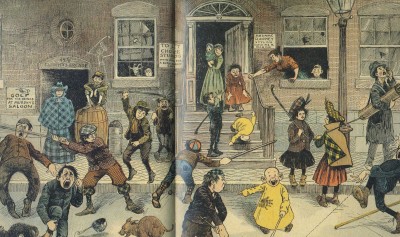
******************************************************************************************************************************** Brownstone Detectives investigates the history of our clients’ homes. The story you are about to read was composed from research conducted in the course of one of those investigations. Do you know the history of YOUR house? ******************************************************************************************************************************** “Ragged little boys, with dirty faces, trousers out behind, who sleep in coal boxes on door mats and stoops, pitching pennies and searching in the gutter.” So began a letter to the Brooklyn Daily Eagle in 1853 from an anonymous reader known simply as “Atlas.” Atlas was wondering why theater in New York did not spring from everyday life – as he saw it. And what he described painted a picture of Brooklyn life that has long drifted away, although it is still with us in other formats. Here are the characters that Atlas saw in Brooklyn in 1853: “Older boys with lips pouring out terrible oaths, disgusting obscenity, the fumes of penny cigars and cheap rum. “Old men tottering from dilapidated vermin-infected tenements, to smoke and drink at some low-roguery, whose greasy, fancy-colored decanters are so enchanting to every Godforsaken drunkard. “Slouchy, course-looking servant girls emptying slops into the gutter, and with pail in hand, stopping to exchange ribaldry with an idle neighbor, and retail scandal about the infidelities of their mistresses. “Faded women, with low-necked dresses, who indulge in very liberal views about virtue and chastity, with painted cheeks and brassy looking countenances, searching for verdant countrymen, to indulge with them in beastly licentiousness. “Lazy wives, with frouzy uncombed […]


