TRUST ME, I’M A…SHOEMAKER? (1900)
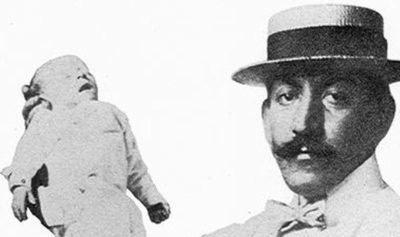
******************************************************************************************************************************** Brownstone Detectives investigates the history of our clients’ homes. The story you are about to read was composed from research conducted in the course of one of those investigations. Do you know the history of YOUR house? ******************************************************************************************************************************** If you stepped into the doctor’s office at 635 Herkimer Street early in 1900, you would have been greeted with the kindly smile of Dr. Walter C. Falk. Dr. Falk would have listened to your heartbeat, asked you a number of questions in a slight German accent, charged you an office visit fee, and then, after disappearing and the reappearing from a back room, prescribed you any number of medications – which he would, of course, sell to you directly. Over the coming weeks, your ailment may or may have not gone away. If it did, it was most certainly not due to the medication for which you paid and took faithfully. For you see, it was very soon discovered that “Dr.” Falk, who had only been in town for approximately eight months, was not a doctor at all. He was a “shoe cutter.” “DR.” FALK, I PRESUME? Falk noted on the 1900 Federal Census that he had been born in Germany in 1848. He was 51 years old at the time and was currently a lodger at the boarding house at 635 Herkimer Street, where he lived with seven other men and a small family. An 1892 New York State Census record, though, showed him living in the town of […]
RUTHLESS RHYMES FOR MARTIAL MILITANTS (1914)
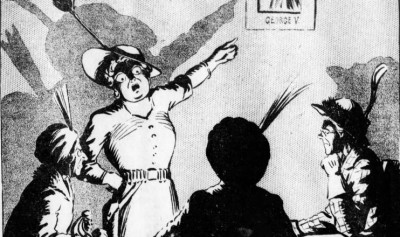
******************************************************************************************************************************** Brownstone Detectives investigates the history of our clients’ homes. The story you are about to read was composed from research conducted in the course of one of those investigations. ******************************************************************************************************************************** To celebrate Women’s Suffrage, we harken back to a day when women suffragettes were pilloried in Brooklyn – publicly – and could not even vote! RUTH-LESS Nothing is easy in life. Women have had it extra hard. Some would argue that it is worse now than it was even back before women had “rights.” But what was it like back then? How high was that glass ceiling? How did Brooklyn treat its women suffering for their rights and the rights of other women? It is not likely that there was much difference between Manhattan and Brooklyn – or Brooklyn and Cleveland, for that matter. It was merely the details that were different – the players, the events, the locations. Brooklyn, though, seemed to have started its anti-suffragette campaign in earnest by having a lark of it in 1914, joking about the movement while sticking the knife in, so to speak, and twisting it with a sort of sinister glee. RHYMES The Brooklyn Daily Eagle, that year, published a series of cartoons by one of its more able cartoonists, Nelson Harding, called “Ruthless Rhymes for Martial Militants.” The cartoons not only showed women in a demeaning light, but they poked fun about their fight for their rights – as well as their chances for success. The cartoons, though clever, were […]
BLOOD ON THE SNOWBALL (1888)
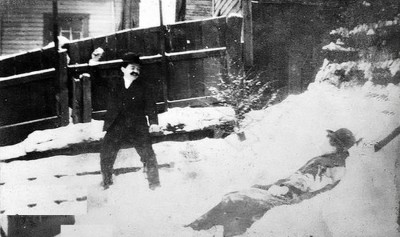
As the snow piled up during the Blizzard of 1888, Brooklynites began to experience countless fights. Snowball fights, that is. Most were lighthearted and fun, romps in the snow bringing joy and relief from the endless shoveling and the stress of everyday life with the white stuff. But sometimes these snowball fights turned ugly, exposing the more unsavory side of Brooklynites. They showed how quickly a snowball fight could evolve from a joyful game into mayhem-filled terror. Two cases, in particular, made the pages of the Brooklyn Daily Eagle during the week of the historic blizzard. One involved a razor. The second involved a gun. THE RAZOR The day after the “Great White Hurricane” struck Brooklyn, Vincent Ciemon was a very tired man. He had reason to be after a long day of shoveling snow following the first full day of the Blizzard of 1888. He had just been employed by the Long Island Railroad Company as that organization needed day laborers to help dig out their engines in the city and beyond. On his way home around 5 p.m., to the apartment where he lived with his family on East New York Avenue in Brownsville, Ciemon had just reached Rockaway Avenue “when a snowball struck him in the back.” Ciemon, identified by the Brooklyn Daily Eagle in the story as “The Italian,” had only a hundred or so feet before he arrived home and so, tired as he was, he did not even turn around to challenge his tormentors. […]
BROOKLYN’S VANISHING STREET ART (2000)
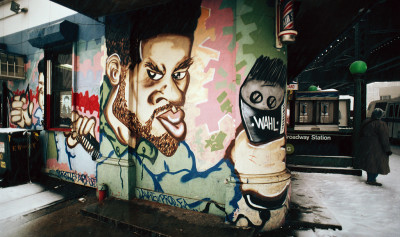
******************************************************************************************************************************** Brownstone Detectives investigates the history of our clients’ homes. The story you are about to read was composed from research conducted in the course of one of those investigations. Do you know the history of YOUR house? ******************************************************************************************************************************** Whether you liked the murals or not, they certainly bore witness to another time in our history, and existed, then, as an integral component of the neighborhood’s fabric. There were memorials to murdered children, commemorations devoted to local or nationally known personalities, and painted demonstrations representing historical struggles. …and then there were examples of this – street art as advertising. This particular tonsorial work of art, once located in the Williamsburg section of Brooklyn, had claimed the lion’s share of the street-level wall of a building at the corner of Heyward and Broadway. Today the street art is long washed away. The building, now housing a corner grocery store, has returned to a closer estimation of how it appeared when the tenement house was built in the late 19th century. Follow @BrownstoneDetec Share ———————————————————————————————————————– The Brownstone Detectives Brownstone Detectives is an historic property research agency. Our mission is to document and save the histories of our clients’ homes. From our research, we produce our celebrated House History Books and House History Reports. Contact us today to begin discovering the history of your home.
SO A TAXICAB JUMPS INTO A FOUNTAIN… (1909)
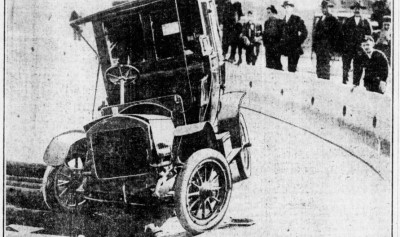
******************************************************************************************************************************** Brownstone Detectives investigates the history of our clients’ homes. The story you are about to read was composed from research conducted in the course of one of those investigations. Do you know the history of YOUR house? ******************************************************************************************************************************** When Brooklyn woke up one April morning in 1909, there in Prospect Park Plaza’s “Electric Fountain” sat a little blue taxicab. To many, the thing appeared as though it had always belonged there. Some wondered whether they’d simply not noticed it all along. But others realized that something was wrong. Something was certainly wrong. THE CASE OF THE IMPETUOUS TAXICAB It seems as though the Grand Army Plaza has always had a fountain. But back when the plaza was called Prospect Park Plaza and it encompassed a larger amount of land, that fountain was much larger and took up much more space. The fountain was then what was called an “electric fountain,” and after it was installed it would attract people by the thousands each year when the lights and the water were turned on. One year, after the winter had passed and after the water was supposed to have filled the reservoir, with the jets darting, and the lights dancing, the fountain sat silent. So, as popular as the fountain was to Brooklyn, the reporters of the city had descended upon Parks Commissioner Kennedy about it’s inactivity. And in the midst of the hubbub – came the crash. HOW IT ALL CAME ABOUT It was 11:30 on a Sunday night […]
THE WILLIAMSBURG FIRE DEPT (1920)
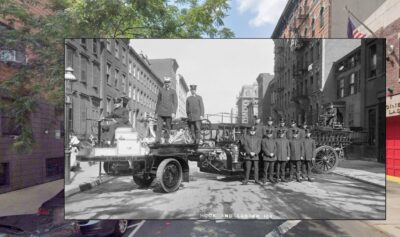
******************************************************************************************************************************** Brownstone Detectives investigates the history of our clients’ homes. The story you are about to read was composed from research conducted in the course of one of those investigations. Do you know the history of YOUR house? ******************************************************************************************************************************** From about the early 1920s, comes this black & white Throwback Thursday photograph of the “Men of Hook and Ladder 104 with a hook and ladder, 161-163 South Second Street,” superimposed on the top of a Google Map (courtesy Department of Records and Google Maps). The second pic shows the same men in front of their engine house. The firehouse was established at this exact location in 1885 and exists to this day there. Follow @BrownstoneDetec Share ———————————————————————————————————————– The Brownstone Detectives Brownstone Detectives is an historic property research agency. Our mission is to document and save the histories of our clients’ homes. From our research, we produce our celebrated House History Books and House History Reports. Contact us today to begin discovering the history of your home.


