POLICE COMMISH LIKES THE LADIES (1915)
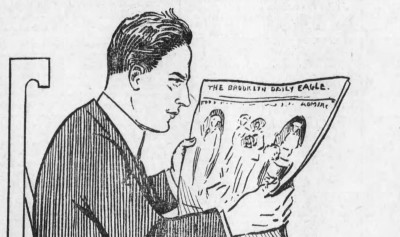
When Brooklyn’s Deputy Police Commissioner Godley laid eyes on the beauties in the newspaper spread, he couldn’t contain himself. He wrote to the Brooklyn Daily Eagle to offer them police protection. “It is unusual for us to offer police assistance, since we ordinarily have enough work to do for all of the policemen we have and a good many more, but I am sure that you will need it after publishing photographs of but four of the beautiful young women of Brooklyn.” So, he made the following offer: “We shall be glad to furnish whatever protection may be necessary even to the extent of calling out the entire force.” The Eagle, in response, offered a poem, the last two stanzas of which we offer here – the first of which comes in the voice of the Deputy Commissioner Godley himself, followed by an answer from the newspaper: “If harm seems to threaten those charming young misses; We’ll keep them in Brooklyn, where nothing but bliss is. But why publish four, when you know that is hardly Fair to other Brooklyn girls? – Yours truly, Godley.” “Dear Godley” – (The Eagle makes haste to respond) “We note your advice, so please don’t despond; Send us lots of photos of beauties – don’t stint ’em; Be assured that The Eagle will be glad to print ’em.” Five years later women would begin to be taken more seriously. No longer just beauties to be gawked at in newspaper spreads, in 1920 they would […]
MOOKIE, A CHILD BRIDE & A PET HORSE
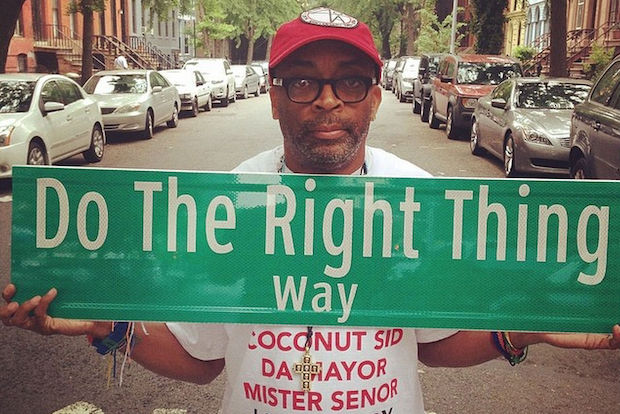
******************************************************************************************************************************** Brownstone Detectives investigates the history of our clients’ homes. The story you are about to read was composed from research conducted in the course of one of those investigations. Do you know the history of YOUR house? ******************************************************************************************************************************** Not much exciting took place at 173 Stuyvesant Avenue throughout its 140+ year history – unless you count 1) Spike Lee’s movie, “Do The Right Thing,” 2) a pet horse, or 3) a child bride. MOOKIE’S CRIB The brownstone where director Spike Lee’s character “Mookie” lived in the 1989 movie, “Do The Right Thing,” 173 Stuyvesant Avenue sits at the corner of Quincy Street. Filmed at various additional locations in Bedford-Stuyvesant – but mostly on Stuyvesant Avenue – “Do The Right Thing” was a commercial success that featured the debuts of Martin Lawrence and Rosie Perez. A few years back, Spike Lee was in the news not only for his vilification of his old neighborhood’s “gentrifiers,” but also for his own request for a change in Bedford-Stuyvesant. Lee saw that change after he lobbied to have Stuyvesant Avenue – between Lexington Avenue And Quincy Street – renamed “Do The Right Thing Way.” YES, VIRGINIA, THERE WAS A HISTORY BEFORE SPIKE LEE Built at some point before 1877, it was listed for rent that year as a “partially furnished,” “two story basement brown stone house.” The owners included a rather interestingly worded phrase in this ad in the Brooklyn Daily Eagle, stating that they were willing to “let the whole or part […]
WONG SING BOW’S WHITE WIFE MINNIE (1877)
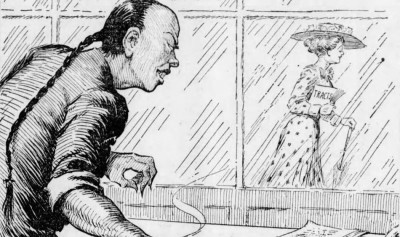
******************************************************************************************************************************** Brownstone Detectives investigates the history of our clients’ homes. The story you are about to read was composed from research conducted in the course of one of those investigations. Do you know the history of YOUR house? ******************************************************************************************************************************** In 1886, the life that Wong Sing Bow had been building up for years began to crumble before his eyes. A naturalized U.S. citizen, Wong Sing had been born “a subject of the emperor of China.” But he had been in America “long enough to save considerable money and to appreciate the beauty of Irish girls,” said one paper of the time. Wong Sing spoke English fluently and was often called upon by the authorities to interpret. With all that Wong Sing had going for him, it had originally seemed likely that he was going to have a good life. But this was the 1800s. And Wong Sing was Chinese. ANTI-CHINESE PREJUDICE IN 19TH CENTURY BROOKLYN After Wong Sing’s arrival in the U.S. around 1870, according to one paper, “the celestial youth immediately fitted himself in the groove of circumstances. “He decided to become intensely American. He shaved his cue off, doffed his Chinese garb, proclaimed his intention to become a citizen, and went to Sunday school ‘all samme like Melican man.’” Apparently, the papers, like most Americans, had no politically correct bent in those days. But the Chinese were located squarely at the bottom of the social construct – just slightly beneath the Irish and the Germans – and so […]
THE CLOCK HOUSE OF CLINTON HILL (1914)
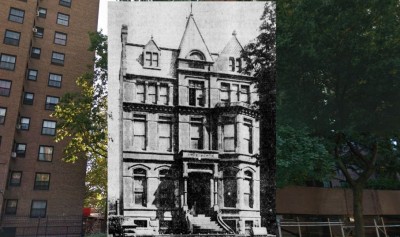
******************************************************************************************************************************** Brownstone Detectives investigates the history of our clients’ homes. The story you are about to read was composed from research conducted in the course of one of those investigations. Do you know the history of YOUR house? ******************************************************************************************************************************** Nothing says “time’s a-wastin’” like the gift of a good clock. And that “tick-tick-tick” on the old mantel back in the day was a constant reminder that there were only a certain number of hours, minutes, and seconds within each day. And, more than anyone else, James Arthur knew it. A CLOCK, A CLOCK, MY KINGDOM FOR A CLOCK! James Arthur, a wealthy industrialist and owner of a machine works in Brooklyn, collected all manner of timepieces. He also fixed them, traded them, dreamt about them, and talked about them all day long – literally. He lectured on clocks, giving hundreds of speeches on timepieces in his lifetime. And as a rich Brooklynite he had a lot of that time on his hands. He traveled. He sought out clocks. He talked some more about clocks through interpreters in foreign lands. Then, at some point, he realized that he needed a home for all of those clocks. And with the number of clocks he owned, it would need to be a big one. No. 357 CLINTON AVENUE – THE CLOCK HOUSE In 1914, Arthur found that place. It wasn’t a new building, and it likely needed some work, but it was grand, had great presence, and – most importantly – it was […]
THE HERO OF THE HALSEY STREET FIRE (1911)
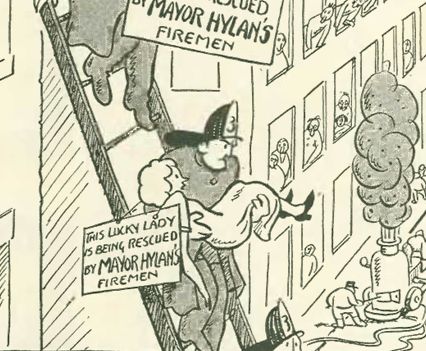
******************************************************************************************************************************** Brownstone Detectives investigates the history of our clients’ homes. The story you are about to read was composed from research conducted in the course of one of those investigations. Do you know the history of YOUR house? ******************************************************************************************************************************** Late in 1911, on a brisk early November morning, a fire broke out in the ground floor store of a 4-story corner apartment building across the street from Saratoga Square Park. It quickly spread, engulfing the entire building. Smoke pouring out of the store on the ground floor of 801 Halsey Street was first seen by a streetcar motorman, William Coffey, who, thinking quickly, began to clang his streetcar gong to arouse the sleeping inhabitants of the building. Coffey and his conductor, along with their six passengers, descended from the car and rushed to the building to do what they could do to assist in evacuating the residents. The fire had apparently started on the ground floor on the Halsey side of the building in a stationery store run by Wolf Bialik. Next door was a grocery store operated by Ernest Seemeyer. The flames then quickly “shot up the dumb waiter shaft to the roof, mushrooming out on each floor.” DETECTIVE O’HARA TO THE RESCUE Across the street, at No. 98 Howard Avenue, a 37-year-old police detective, Irving A. O’Hara, upon hearing the street car gong, had begun dressing quickly and rushed across the street to assist. By this point, the three families living in the building had made it out […]
A CARIBBEAN HISTORY OF BED-STUY (2014)

“There is more serendipity in heaven and earth, Horatio, than is dreamt of in your philosophy.” Although that is not an exact quote from Shakespeare, it is close enough for my purposes. It very adequately lends a certain je-ne-sais-quoi to a chance experience I had a few years ago here in Bedford-Stuyvesant. FINDING AUNT CAR It was 2014, I found a posting on a genealogical site by a woman searching for information about a relative of hers named Caroline Gill. Since, at that time, I had been researching the lineage of my home – a 120-year-old brownstone in the Bedford-Stuyvesant section of Brooklyn – I knew that one of the previous owners of my house went by that name, so my interest was piqued. I responded to the APB-like message and gave what information I had, hoping for an exchange. As it turned out, that poster, Stacey Maupin Torres, had more information about Caroline than I had ever found. This she began to share with me in what can only be described as pages of beautifully descriptive prose. I could tell that there was love in her words and I consumed them with an avid interest. In one of her emails, though, she casually mentioned some information that I was sure that she didn’t know I already possessed. She told me that her “Aunt Car” had lived in a beautiful old brownstone at 738 Macon Street in Brooklyn – the house my husband and I had been living in for […]


