THE METAMORPHOSIS OF A BROOKLYN BLOCK
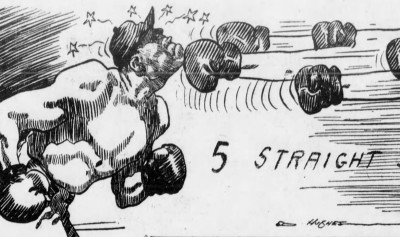
After showcasing some serious open-air ball playing, Saratoga Field was about to go indoors. There it would bear witness to a number of more diverse activities – dancing, fighting, and dreaming. But not necessarily in that order. By 1912, the owners of the block that Saratoga Field had utilized would realize the cash potential of developing the grounds for its marketing to commercial investors. Accordingly, they divided the land up into lots and sold it all off to real estate developers. Shortly afterwards, three new entertainment businesses would appear on the block – the Broadway Boxing Arena, the Halsey Theatre, and the Arcadia Dance Hall, all just across the street from the Brooklyn Rapid Transit (BRT) carbarn and Saratoga Square. THE BROADWAY ARENA The Broadway Arena (also known as the Broadway Sporting Club and the Broadway Exhibition Association Building) sat next to the Halsey Theatre (an alley in between), operating for close to 40 years. It was built around 1912 and had a capacity of 4,500 people. It would become Brooklyn’s top fight arena in the 1930s and 1940s, exhibiting the boxing skills of some of the country’s more well-known fighters, such men as Al Tiernan, Arturo Godoy (who fought Joe Louis in 1940), and Pete Sanstol. By 1951 the Broadway Arena was closed, the victim of competition from the television set. Its last boxing match was held on 29 November 1951. THE HALSEY THEATRE The Halsey Theater, a 2,100-seat theater, which originally presented both vaudeville and silent movies, was […]
ROASTING CORK IN A “HEIGHTS” FIRE (1907)
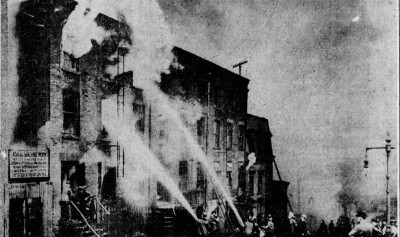
The Jehovah’s Witness complex in Downtown Brooklyn was once the scene of a roaring early morning 4-alarm fire that threatened to destroy the vast warehouse district that existed there in 1907. Sitting along the waterfront at the location of the fire – on both Columbia Heights and Furman Street – was a cork company, a coffee roasting factory, and an ice plant. SAVING THE WAREHOUSES It is not known where exactly within the complex the fire broke out, but it was determined by many of the residents of the district that the aroma of burnt coffee and cork did not make for a attractive combination that morning. The “oily reek of cork” was in the smell of the smoke throughout the morning, while roasted coffee – roasted twice over – brought residents to realize which warehouses were caught within the conflagration. The buildings in the picture above sat on what is now the Jehovah’s Witness compound and comprised a number of private homes that were still existent within the old warehouse district. Among them was “a frame house of the old style sort, two stories in height, with a mansard roof for an attic.” And in that building Catherine O’Neill, 50, and her bedridden sister, Agnes O’Neill, 65, both former “schoolma’rms,” feared for their lives. SAVING THE SCHOOLMARMS Patrolman Keating, who sounded the alarm, grew concerned as their building was shrouded in black smoke. No one had seen the two women that morning, and he “feared that something had happened to them.” So, […]
92 ROUNDS IN IRISH RED HOOK (1864)

******************************************************************************************************************************** Brownstone Detectives investigates the history of our clients’ homes. The story you are about to read was composed from research conducted in the course of one of those investigations. Do you know the history of YOUR house? ******************************************************************************************************************************** It was an amazing feat even for the times. Although fights were often arranged for the amusement of their onlookers or the profits of the inevitable bettors back then, unauthorized prize fights were, even in 1864, against the law. It was in that year that just such an illegal “Feather Weight” contest was arranged, “in the rosin yard at the foot of Van Brunt street at 7 o’clock” the morning of 4 December. IRISH BARE-KNUCKLE BOXING The Irish, it was maintained, were known for their fighting spirit, and Red Hook, having no dearth of wiry Irish lads looking to swing a punch or two at any adversarial comers, this particular match did not appear to be an uncommon occurrence. There was no main stake in the result of the fight, noted the Brooklyn Daily Eagle, but “small bets were plentiful, and over $1,000 in greenbacks were said to have changed hands on the issue.” The Brooklyn Daily Eagle called the affair “disgraceful,” but then went on to describe the “prize fight” and its participants in the most glowing and respectful tones, noting that “the lovers of the manly art rejoiced.” THE CONTESTANTS One of the boys was Paddy McGrath, “who belongs at the corner of Van Brunt and Wolcott street when […]
THE GREENEST BLOCK IN BROOKLYN (1902)
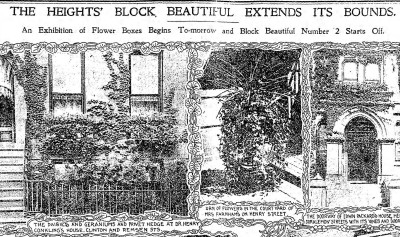
******************************************************************************************************************************** Brownstone Detectives investigates the history of our clients’ homes. The story you are about to read was composed from research conducted in the course of one of those investigations. Do you know the history of YOUR house? ******************************************************************************************************************************** As the judging for this year’s “Greenest Block in Brooklyn” award heads into its final round, we bring you a history of the concept of beautifying and greening neighborhoods in the borough of Brooklyn. A BRIEF HISTORY OF BLOCK BEAUTIFICATION IN BROOKLYN Before the Botanic Garden arrived on the scene with its “Greenest Block in Brooklyn” initiative in the 1990s, there was “Block Beautiful.” A number of private Brooklyn citizens, wishing to bring about the greening of their neighborhood, initiated an organized effort to stimulate an active interest in its residents utilizing their green thumbs to good effect. This earliest organized “block beautification” project began somewhat simultaneously in 1902 on two separate streets and section of the borough – Henry Street (in Brooklyn Heights) and on Quincy Street (in the Bedford Section). Led by Miss Zella Milhau of 291 Henry Street, the effort was called “Block Beautiful,” and was an initiative to “green” the block upon which she and her family lived, with the hope that this effort would be replicated throughout the city. Milhau, an artist and active member of the Municipal Art Society and the Fine Arts Club of Manhattan, who lived in the Columbia Heights section on Henry Street between Joralemon and State streets, originated the idea and got […]
UNPRINCIPLED MONKEY-FACE (1843)
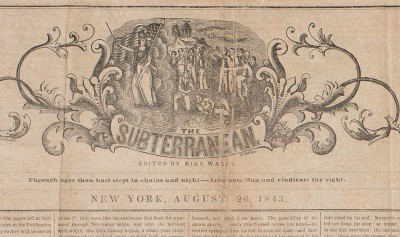
Newspapers in the early 1800s had fewer guidelines to follow than today’s papers do. The only serious standards editors were certain to follow back then were those concerning making money and keeping the number of libel lawsuits down. One Manhattan newspaper, The Subterranean, truly lived up to its name in terms of the depths the owners would go to expose the dirt of others living upon the island at the time. “If the unprincipled, monkey-faced blackguard with dirty whiskers, who works in a cooper’s shop in First street, near Avenue A, does not desist in his disgraceful annoyance of the young ladies in Houston street, we shall strip the hide off of him,” the paper’s editor wrote, in an attempt to sully the already low reputation of a certain character residing in what would be today’s Bowery. “We have been informed that he stole two work bags the other evening, and would have committed other depredations, were it not for the timely interference of a young butcher, who chastised him on the spot.” The Subterranean, which was “committed to the interests of the working classes” and was written for at one time by Walt Whitman, was literally replete with colorful stories about various “fanatical traitors, bigoted sectarians, speculators, robbers, bankers and brokers…” According to the American Antiquarian Society, who wrote a story about the conservation of a copy of the 1843 newspaper, “People were named outright, so it’s not surprising these papers were found in the N.Y. District Attorney’s office […]
THE FILTHY STREETS OF STUY HEIGHTS (1891)
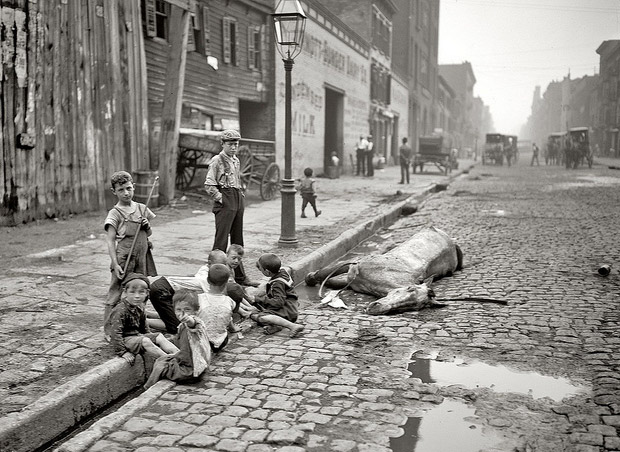
******************************************************************************************************************************** Brownstone Detectives investigates the history of our clients’ homes. The story you are about to read was composed from research conducted in the course of one of those investigations. Do you know the history of YOUR house? ******************************************************************************************************************************** “I have lived in Macon Street since Nov. 28, and there has not been a soul to clean that street during that time.” It happened then as it does now – people complain about the condition of their streets and their neighborhood, in general. The above quote was from 1891, back when Stuyvesant Heights was in the throes of a major construction expansion. Apparently, there were construction materials everywhere – filling the streets and clogging the sewers. “There are at least a thousand tons of sand and stone in the street with grass growing all over it,” the same commenter noted. “The sewer is filled up with sand.” It got so bad for this section of town – due to the relatively unregulated construction industry – that every time there was a heavy rain storm, the article continued, residents’ cellars were “flooded with one or two feet of water.” Ironically, our current 21st century Mayor’s Office declared a few years ago that the streets of Bedford-Stuyvesant were among the dirtiest in the city. Specifically, the office noted that the cleanliness of 15% of our streets was “unacceptable.” Now that Bed-Stuy is a built-up section of our city, maybe we don’t have much of an excuse for the filth. But it must […]


